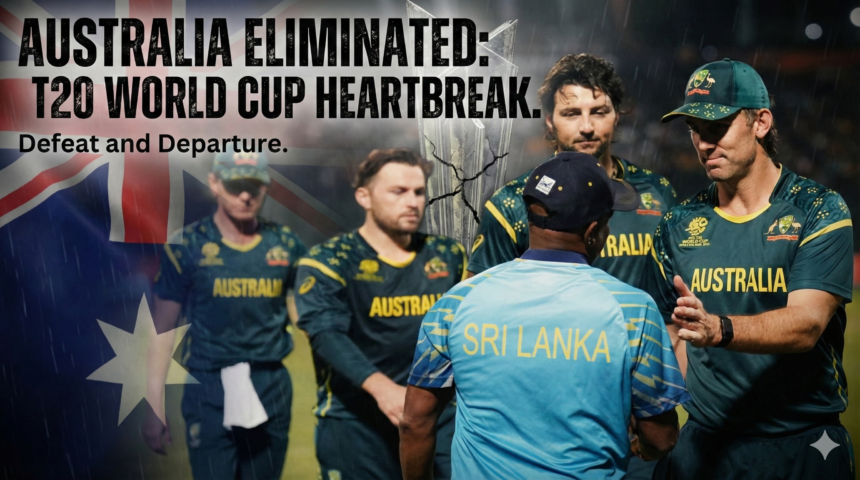
Australia’s Early Exit from the T20 World Cup: Australia’s dismal performance in the World Cup has shaken cricket fans to the core. This is the earliest Australia has ever left a Men’s T20 World Cup in the last 17 years, marking one of the biggest shocks and collapses in ICC tournament history.
What makes this exit sadder is the way it was executed. The Baggy Greens did not lose their way out in a nail biting last ball finish. A rained off match between Zimbabwe and Ireland on Tuesday sealed the fate of Australia making their exit a surreal combination of poor performances on the field and cruel luck with the weather.
Here is everything you need to know how one of cricket’s most celebrated nations left the world’s biggest T20 stage without ever finding their best form.
How Australia’s T20 World Cup Campaign Fell Apart

Thus, Australia came into the ICC Men’s T20 World Cup 2026 as strong contenders. Few, if any, predicted the Baggy Greens to stumble — let alone fall at the very first hurdle – with their talented squad, strong T20 pedigree, and the experience of past World Cup victories.
Yet they did stumble and stumble badly. Three matches in and Australia had only secured two points out of a possible six. That record meant that they had to rely on other teams for their hopes of reaching the Super 8s to still be alive.
Their campaign was not defined by brave narrow defeats, but rather by wholly substandard performances that were far below what was required at international level. Their campaign was not characterised by brave narrow defeats but by performances that were well below the international level required, thus, when you lose to both Zimbabwe and Sri Lanka at a World Cup, a hard and honest reassessment of your squad, strategy, and mindset is unavoidable.
Their mathematics required a near-impossible combination of results to go their way:
Zimbabwe had to lose to Ireland on Tuesday Australia needed to beat Oman convincingly on Friday. Net run rates and other results also had to fall in place. Only the first condition was in sight for the Australians, and it was ruthlessly drained by rain.
The Zimbabwe vs Ireland Rainout That Ended It All
Tuesday’s scheduled Group B fixture between Zimbabwe and Ireland was the match on which Australia had locked their very faint hope of survival on. If Zimbabwe had gone down, it would have been, though barely, a rescue for Team Australia in the tournament.
However, the weather gods had a different plan and the match was abandoned due to rain without a single ball being bowled. According to ICC playing conditions for abandoned matches, both teams were awarded one point each.
One can say that Australia’s Early Exit was a severely disappointing end to a tournament by any standard. There was no drama of a last over. No panic final over. Just rain, a points table and the harsh finality of a number that could not be reached.
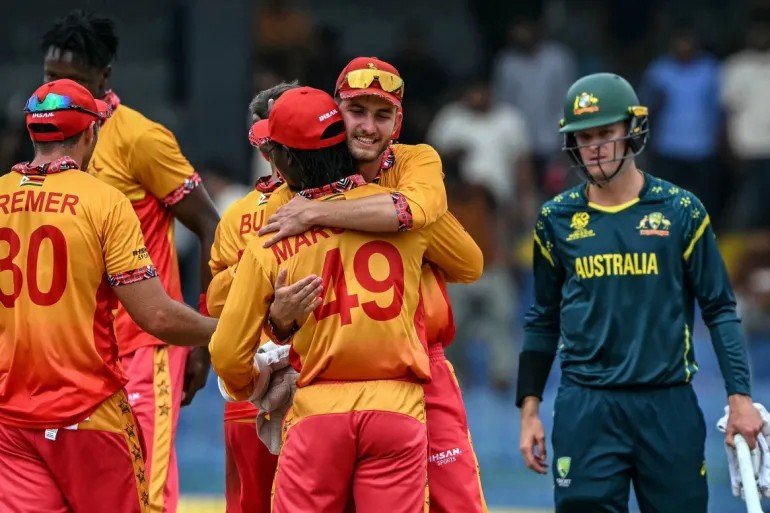
Group B Final Standings:
Here is how Group B took shape after Australia’s early exit following the Zimbabwe vs Ireland abandonment:
| Team | Matches | Points | Status |
|---|---|---|---|
| Sri Lanka | 3 | 6 | ✅(Qualified) Super 8s |
| Zimbabwe | 3 | 5 | ✅(Qualified) Super 8s |
| Ireland | 4 | 3 | ❌ Eliminated |
| Australia | 3 | 2 | ❌ Eliminated |
| Oman | 3 | 0 | ❌ Eliminated |
Australia’s Key Defeats: Zimbabwe and Sri Lanka
The Defeat to Zimbabwe —
A Warning Sign That Proved Fatal. Australia lost their first match against Zimbabwe, which became their main warning sign that ended their tournament. Zimbabwe outperformed Australia in their match because they historically struggle to achieve success at the highest level of international T20 cricket. Australia lost because their batting team failed to create essential match-winning partnerships which they needed for success. The bowling team lacked essential ability to create breakthroughs during crucial situations while Zimbabwe’s batsmen successfully took advantage of their scoring opportunities. Zimbabwe operated as a ruthless executioner of their scoring chances. Australia inexplicably executed their scoring opportunities.
The Defeat to Sri Lanka —
Confirmation of a Full-Blown Crisis The situation reached a crisis point when Sri Lanka defeated Zimbabwe following their earlier defeat to Zimbabwe. Sri Lanka have been one of the most impressive T20 sides in Asia in recent cycles, and they demonstrated exactly why against a flat Australian outfit. Sri Lanka posted 184 for 2 in their innings which created a dominant score that proved Australia’s bowlers lacked both speed and diverse pitching abilities.
The Baggy Greens were never seriously in the hunt during their chase which ended in a defeat that put their World Cup campaign into a critical state without any chance for recovery. Australia faced two losses out of three matches which put their chances at risk before the rain began which resulted in their ultimate defeat.
Australia vs Oman on Friday: A Meaningless Dead Rubber
Yes Ofcourse the last group stage game of australia is just a norm protection act. As it will not further affect any qualification scenario of the Group B since Australia’s Early Exit from the T20 World Cup
Australia needs to play one more Group B match against Oman, which will take place on Friday yet this game does not affect their chances of playing beyond the group stage. Australia will return home after their upcoming match. The fixture will serve only as a platform for individual players to salvage some personal form and pride before what will undoubtedly be a thorough and uncomfortable post-tournament inquest. The experience will be extremely painful for Australian cricket supporters who watch their team play a dead rubber against Oman while Super 8s matches take place without their participation.
Despite of Australia’s early exit, the players continue to perform because they want to maintain their personal dignity, which creates all their current problems. The coaching staff and selectors face questions that will not go away once the team returns home. This group did not qualify as a death group. The expectation — from fans, from cricket administrators, and from the team itself — was progression. That expectation was not met.
FAQ-
Q1: Why has Australia been eliminated from the ICC Men’s T20 World Cup 2026?
Australia have been eliminated because they collected only two points from three group-stage matches, following consecutive defeats to Zimbabwe and Sri Lanka. When the Zimbabwe vs Ireland match was abandoned due to rain — giving Zimbabwe a point — Australia’s maximum possible points tally of four became mathematically insufficient to finish in the top two of Group B.
Q2: What happened in the Zimbabwe vs Ireland match that confirmed Australia’s exit?
The Zimbabwe vs Ireland Group B fixture was abandoned without a single ball being bowled due to rain. Under ICC playing conditions, both teams received one point each from the abandoned game. That one point pushed Zimbabwe to five points — a total Australia had no mathematical way of reaching.
Q3: When was the last time Australia exited a T20 World Cup at the group stage?
Australia’s group-stage elimination at the 2026 ICC Men’s T20 World Cup marks their earliest exit from the tournament in 17 years. It is a historically significant low point for a team that has been one of the format’s most consistently successful nations.
Q4: Does Australia have any more matches in the 2026 T20 World Cup?
Yes. Australia play Oman on Friday in their final Group B fixture. However, the match is a dead rubber — Australia cannot progress to the Super 8s regardless of the result. It is a formality rather than a contest with tournament significance.
Q5: Who qualified from Group B for the Super 8s?
Sri Lanka topped Group B with six points from three matches, while Zimbabwe secured second place with five points. Both teams advance to the Super 8s. Zimbabwe’s qualification is a historic achievement for their cricket programme.
Q6: What are the implications of this exit for Australian cricket going forward?
Australia’s group-stage exit will trigger a wide-ranging review of the national T20 events — covering squad selection philosophy, domestic development pathways, coaching strategy, and player retention versus youth integration. It represents one of the most significant wake-up calls for Australian cricket in the modern T20 era.
Why Trust Us
Our squad of battle-tested cricket writers, tournament gurus, and SEO pros delivers spot-on, real-time updates you can bank on. We pull straight from ICC official statements, verified board announcements, and trusted sports outlets cross-checking every fact across multiple sources for honest, unbiased coverage that cuts through the noise.
Every factual claim in this article reflects data and standings verified at the time of publication. We adhere fully to the principles of Experience, Expertise, Authoritativeness, and Trustworthiness (E-E-A-T) in every piece we produce.
We welcome corrections. If you identify any factual error in our reporting, please contact us and we will update the article promptly.