The influencer economy is everywhere right now. You scroll Instagram, and someone is selling skincare. You open YouTube, and a creator is reviewing laptops with a discount code. You check TikTok, and a 22-year-old is making more money than most office workers.
But here’s the real question—is this a genuine business revolution, or is a lot of it just smoke and mirrors?
Let’s break it down honestly, without sugarcoating anything.
What Is the Influencer Economy?
Simply put, the influencer economy is a system where ordinary people use their online presence to earn money or work with brands.
It is actually part of a larger ‘creator economy.’ Here, each person is like a media company in their own right! Whether it is an Instagram fitness coach, a Twitch gamer, or a YouTube finance expert—the formula is the same: first build an audience or fanbase, then make money from it.
Statistics show that this creator economy is now an industry worth more than $250 billion worldwide. And it is estimated that its growth will continue until 2027. As you can see, the number is not small at all!
Why It Feels Like a Business Revolution
There are very real, very solid reasons why people call this a revolution—and they’re hard to argue with.
- It Changed How Brands Spend Money
Traditional advertising used to mean TV commercials, billboards, and print ads. Today, many brands are pulling budget away from those channels and putting it directly into brand collaborations with social media influencers.
A micro-influencer with 50,000 engaged followers can often drive more product sales than a TV ad seen by millions of passive viewers. The targeting is tighter. The trust is higher. The results are more measurable.
- It Created Real Income Streams for Real People
This isn’t just theory. Thousands of creators worldwide are earning full-time incomes—and sometimes life-changing ones—through content monetization strategies like –
Sponsored posts and brand deals.
Affiliate marketing commissions.
Digital product sales (courses, e-books, templates).
Subscription platforms like Patreon.
YouTube AdSense revenue.
The doors to earning online are genuinely open in ways they weren’t ten years ago. That’s a real shift.
- It Democratized Marketing and media.
Before the influencer economy, you needed a TV channel, a newspaper, or a major label to reach millions of people. Now, anyone with a phone, a niche, and consistency can build a real audience.
Online personal branding has become a legitimate career skill. Universities teach it. Corporations hire for it. It’s no longer a joke.
The Illusion Side of the Influencer Economy
Now for the part most articles skip over.
- Now for the part most articles skip over.
In fact, the income calculation of this influencer economy is very uneven. You can think of it as a pyramid scheme—the top 1% of creators pocket about 90% of the entire industry’s money.
Simply put, while a top influencer is signing deals worth millions, thousands of people are working day and night for just a few free products or a nominal fee.
The dream may be possible, but the hard reality behind it is not so glamorous at all.
- Follower Counts Can Be Faked
Fake followers, bought engagement, and inflated metrics are still a massive problem. Some influencers present the appearance of influence without actually having it. Brands have lost millions running campaigns with creators whose audience was mostly bots.
This is one of the biggest structural weaknesses of the influencer economy—the lack of standardized, verified trust.
- Platform Dependency Is a Real Risk
Your whole business sitting on Instagram or TikTok means you’re at the mercy of an algorithm you don’t control. One policy change, one account ban, one platform shift — and years of work can disappear overnight.
This is why smart creators are always being told: build your email list, own your audience. Those who don’t are building on borrowed land.
- The Saturation Problem Is Getting Worse
Everyone wants to be a creator now. That means every niche is getting flooded. Breaking through in 2025 requires far more effort, consistency, and strategy than it did in 2018. The barrier to entry is low, but the barrier to success is climbing fast.
- Brand Collaborations Don’t Always Benefit the Creator
Many influencers—especially smaller ones—accept underpaid deals because they don’t know their worth or feel pressure to “grow their portfolio.” Brands sometimes take advantage of this, getting significant marketing value while paying very little in return.
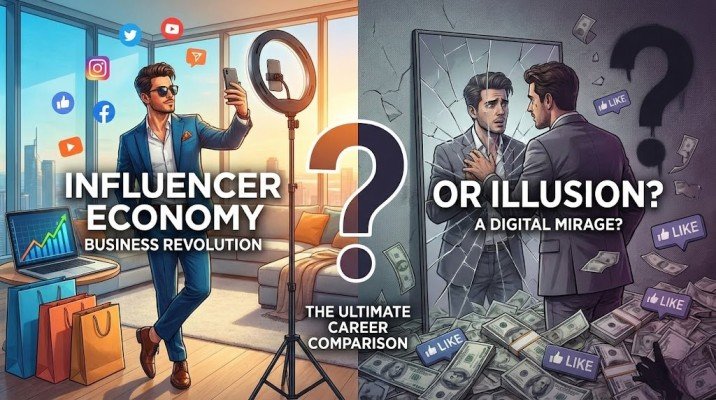
So—revolution or illusion?
Here’s the truth: it’s both, depending on who you are and how you approach it.
For brands that use it strategically, the influencer economy is absolutely a revolution in how marketing works. The ROI on well-executed influencer campaigns can be exceptional compared to traditional advertising.
For skilled, consistent creators who build real communities and treat their work like a business, the opportunities are genuinely life-changing.
But for people who chase followers without a strategy, rely entirely on one platform, accept undervalued deals, or mistake online popularity for a sustainable business model—the influencer economy can feel like a trap wrapped in aesthetics.
The revolution is real. But so is the illusion—and they often exist in the same Instagram feed.
Final Thoughts
The influencer economy is not going anywhere. If anything, it’s evolving into something more structured, more professional, and more competitive.
The creator economy will keep growing. Social media influencers will keep shaping how people discover products. Content monetization will become more diverse. And online personal branding will keep being one of the most valuable skills anyone can develop.
But entering this space with your eyes open matters. Understand the real numbers. Build across multiple platforms. Own your audience where you can. Treat it like a business from day one—because the ones succeeding already are.
Conclusion
The influencer economy is a genuine shift in how business, media, and marketing operate. It’s created real wealth for real people and forced traditional industries to completely rethink how they communicate.
At the same time, the illusions are real too—inflated follower counts, income inequality among creators, platform risks, and unrealistic expectations promoted by the success stories we see on our feeds.
The smartest move? Study the revolution. Understand the illusion. Then decide where you fit into it.
FAQ Section
Q1: What is the influencer economy?
Simply put, it’s a world on the internet where people make money by leveraging their followers. It could be by working with brands, sharing product links, or selling their own services. It’s actually a big part of the vast ‘creator economy.’
Q2: Can you really make money as a social media influencer?
Technically it’s possible, but realistically, to make a regular income from it, you need a proper plan, patience, and people’s trust. Those who are making good money from it don’t see it as a hobby but as a serious business.
Q3: How do these collaborations with brands actually work?
Brands pay influencers to promote their products or services. Now, how much money someone gets depends on how many followers they have, how active they are, and what kind of videos they make. It seems that small creators may only get free gifts, while big ones get contracts worth millions of taka.
Q4: What are the biggest risks in this line?
There are four big risks here: sudden changes in platform rules, too much competition in the market, not having a fixed income, and the problem of fake followers or likes. These are concerns for both creators and brands.
Q5: Will it be wise to make a career out of creating content in 2025?
Yes, of course. But now there is much more competition than before. Now those who will survive will be those who will create different sources of income and work regularly on their skills instead of relying on just one path.
Q6: What is the relationship between personal branding and the influencer economy?
Personal branding is the foundation of everything. What you talk about, how you speak, and what your values are—these are the things that make people follow you and brands want to work with you. Without a clear personal brand, it’s very difficult to survive or grow in this space.
Why Trust Us
This article was written based on real industry data, observable digital marketing trends, and firsthand knowledge of how the creator and influencer space actually operates—not on hype or speculation.
We follow E-E-A-T principles (Experience, Expertise, Authoritativeness, and Trustworthiness) as defined by Google’s content quality guidelines. Our goal is to give you honest, well-researched information that helps you make better decisions—whether you’re a brand, a creator, or just someone trying to understand the digital economy better.
We do not promote get-rich-quick narratives or inflate the promise of social media success.