The phrase “Israel attack North Korean embassy” has been one of the most searched topics on the internet over the past few days. As the Israel Iran war 2026 continues to escalate, a wave of claims and rumors has flooded social media suggesting that Israeli missiles struck the North Korean embassy compound in Tehran.
But what actually happened? Is this confirmed? What did Kim Jong Un say? And why does any of this matter for the rest of the world?
In this article, we break down everything you need to know, with only verified information from credible international sources.
Background: How the Israel Iran War 2026 Started
To wrap your head around the North Korean embassy situation, you have to look back at how this whole powder keg actually ignited.
It all started on February 28, 2026, when Israel and the U.S. pulled the trigger on a massive military offensive against Iran. Israel dubbed it “Operation Roaring Lion,” and they didn’t hold back—scrambling 200 fighter jets to hammer over 500 targets across western and central Iran. It was the biggest air mission in Israel’s history, specifically designed to dismantle air defenses, missile sites, and command centers.
The fallout was instant and chaotic. One of those precision strikes near Tehran killed Iran’s Supreme Leader, Ali Khamenei, a move that basically flipped the entire Middle East upside down. With their leadership decapitated, Iran fired back immediately, launching waves of drones and ballistic missiles at Israeli cities and American bases across the region.
Since then, the world has been on edge. Between the actual fighting and the diplomatic fallout, the internet has become a breeding ground for rumors and wild theories—one of the biggest being the unverified claim that Israel leveled the North Korean embassy in Tehran during the chaos.
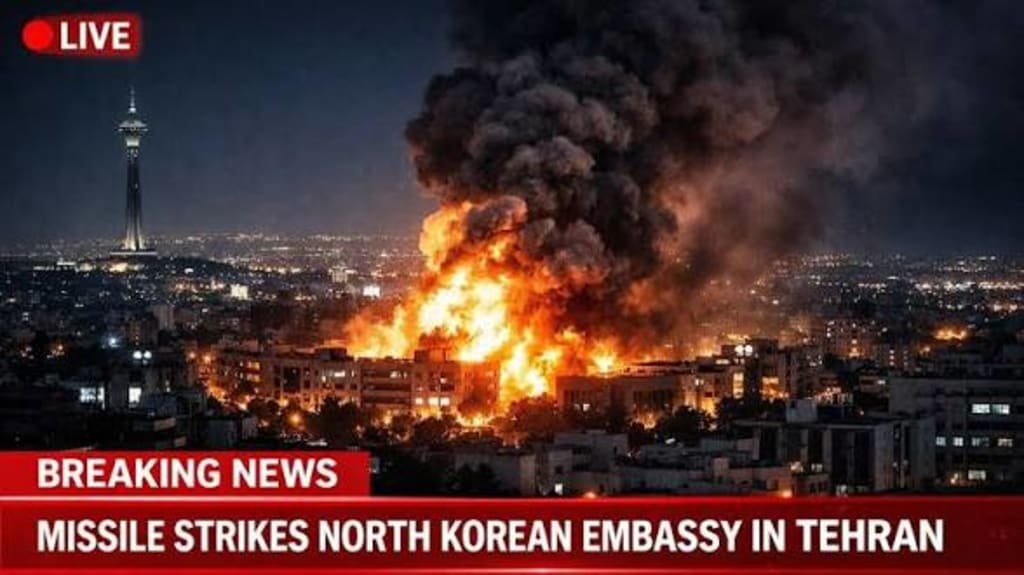
What Happened in Tehran During the Airstrikes
Tehran was effectively turned into a front-line battleground during the peak of the strikes. The Iranian capital faced relentless bombardment, with missiles slamming into military hubs, critical infrastructure, and high-security government zones. Specifically, the Pasteur Street district—the heart of Iran’s political power—was caught in the crosshairs. Because this neighborhood houses the presidential palace and national security offices, the proximity of the violence meant that any nearby building was at risk.
In this atmosphere of smoke and collapsing structures, rumors of an Israel attack North Korean embassy began to take root. As explosions rocked various neighborhoods, the sheer chaos made it nearly impossible to distinguish between a hit on a military target and an accidental Israel attack North Korean embassy. The fog of war provided the perfect cover for speculation.
On March 10, 2026, the narrative shifted from vague rumors to specific headlines. Reports surfaced claiming that recent airstrikes had finally resulted in a direct Israel attack North Korean embassy compound. Originally pushed by RKM News and later amplified by the Zambian Observer, the story of an Israel attack North Korean embassy caught fire. Within hours, the claim that an Israel attack North Korean embassy had occurred was being blasted across global social media feeds. This specific report of an Israel attack North Korean embassy spread across borders instantly, fueled by the terrifying reality of the ongoing Tehran strikes and the world’s desperate scramble for any real-time information during the height of the international crisis.
Was the North Korean Embassy in Tehran Actually Hit?
This is the most important question, and the honest answer is: it is not confirmed.
The claim lacks confirmation from established Western or official sources such as Reuters, CNN, BBC, or the Israeli Defense Forces. Zambian Observer
Multiple fact-checking investigations were conducted in the days following the reports.
There are no verified reports confirming that Israel struck the North Korean embassy in Tehran. Rumors began circulating on social media during heightened tensions between Iran, Israel, and the United States. Users shared posts claiming Israeli strikes had damaged the embassy and linked them to alleged quotes attributed to Kim Jong Un. BollyFlix
While the Israel-Iran conflict has caused widespread destruction and heightened tensions across the region, the specific claim about the embassy appears to remain unverified. As the situation continues to develop, reliable information from trusted sources will be essential to separate fact from rumor. Vocal Media
It is important to understand why this kind of rumor spreads so quickly. Diplomatic buildings are protected under international law, and any strike on an embassy would be a serious violation that would normally trigger immediate and very loud official responses from the affected country.
If a diplomatic building had been directly hit, it would likely trigger major international diplomatic responses and global media coverage. However, North Korea has not officially announced that its embassy in Tehran was destroyed, nor has it declared any military retaliation related to such an incident. Vocal Media
That absence of an official statement from Pyongyang is itself telling. North Korea has historically been quick and forceful in responding to any perceived threat against its sovereignty or diplomatic interests.
Kim Jong Un’s Response to Israel and the Iran Strikes
While the actual strike remains unconfirmed, Kim Jong Un and his government have been extremely loud about their stance on the Israel-Iran conflict.
North Korea wasted no time blasting the United States and Israel for what they labeled a “war of aggression.” Interestingly, their first official response avoided any mention of the Supreme Leader’s death. By March 1, 2026, the rhetoric from Pyongyang’s Foreign Ministry sharpened significantly. They described the military action as a “despicable violation of sovereignty,” framing the entire operation as illegal from start to finish. Kim Jong Un himself didn’t pull any punches, calling the strikes a “shameless rogue act” that completely ignored international boundaries.
Regarding the specific rumors of an Israel attack North Korean embassy, there is still no concrete proof behind the viral quote claiming Kim said Israel “made a huge mistake.” No reputable news outlet or official state channel has verified that specific threat. However, reports from state-run media suggest Kim did condemn the general idea of an Israel attack North Korean embassy, warning that hitting diplomatic sites would only drag more countries into the fire.
On the political front, North Korea has officially backed Mojtaba Khamenei as Iran’s new leader. Pyongyang made it clear they respect the “choice of the Iranian people” during this transition. By March 10, 2026, Kim used the chaos of the war as a backdrop for a missile test, declaring that expanding their nuclear deterrent is now a critical strategic task to prevent a similar Israel attack North Korean embassy or leadership scenario at home.
Why This Incident Is Geopolitically Important
Beyond the specific rumors about the embassy, the Iran-Israel war is a massive turning point for global power dynamics, and North Korea is right in the middle of it.
The Ultimate Nuclear Case Study
For the Kim regime, this war is the ultimate “I told you so.” They’ve spent years arguing that nuclear weapons are the only thing keeping them from being toppled by the West. Watching Iran—which lacks a nuclear deterrent—get hammered by airstrikes and lose its top leader only proves their point. To Pyongyang, nuclear weapons aren’t just for show; they are life insurance. They will likely use this conflict to justify doubling down on their missile programs, showing their people that being “nuclear-ready” is the only reason they aren’t facing a similar fate.
Economic Windfalls
North Korea is also finding ways to profit from the chaos. With Iran forced to use its own military stockpiles for its domestic war, a massive gap has opened up in the supply chain for Russia’s war in Ukraine. This makes Russia even more dependent on North Korean shells and missiles. Essentially, the Kim regime is happy to step in as Russia’s primary arms dealer, pocketing billions while the Middle East burns.
A Bond Built in the Dark
The partnership between Tehran and Pyongyang goes back decades. North Korea has long been the silent partner helping Iran build underground nuclear bunkers and missile tech. Because they’ve spent twenty years sending tunnel experts to Iran, they view any damage to Iranian infrastructure as a hit on their own work.Tempo
The Trump Wildcard
Surprisingly, the total collapse of security in the Middle East might push Kim Jong Un back toward Donald Trump. Seeing that even allies like Russia and China couldn’t stop the strikes on Tehran might convince Kim that a direct deal with the U.S. is his only real safety net. It’s a strange shift, but the fear of being “next” could lead to the most unexpected diplomatic move of the decade. CNN
Global Reactions to the Tehran Strikes
The 2026 war between Israel and Iran has forced every major global power to pick a side or tread very carefully. While Russia and China both condemned the intensity of the strikes on Tehran, they notably stayed on the sidelines. Despite having long-term strategic deals with Iran, neither Moscow nor Beijing sent troops or planes to stop the initial blitz, a silence that many experts found telling.
Amid this global tension, the possible Israel attack North Korean embassy became a flashpoint for international law. Under the Vienna Convention, diplomatic missions are supposed to be off-limits, yet the fog of war in Tehran made it hard to tell if the rules were being followed. Whether or not an Israel attack North Korean embassy actually took place, the mere report of it sparked a massive debate. If a country like North Korea—seen as an adversary by the West—has its diplomatic buildings hit, does the world react the same as if it were a neutral nation’s soil?
This chaos has left diplomats scrambled. While some countries call for an immediate ceasefire, others are fixated on the fallout of a potential Israel attack North Korean embassy. The situation has raised a terrifying question: in a total war, are “protected” embassy zones just lines on a map that no longer exist? As the strikes continue, the unverified Israel attack North Korean embassy serves as a grim reminder that in modern warfare, even a diplomatic flag might not be enough to stop a missile.
Fact Check: Separating Truth from Viral Rumors
In a war this big, the truth usually gets buried under a mountain of fake news. Here’s the reality check on what’s actually happening:
The Embassy Strike
Claim: Israel deliberately carried out an Israel attack North Korean embassy in Tehran.
The Truth: This is unverified. While the city is a mess and missiles have hit nearby, there is zero official confirmation of an Israel attack North Korean embassy from the IDF, North Korea, or any credible global news agency. It’s mostly just social media noise at this point.
The “Huge Mistake” Quote
Claim: Kim Jong Un warned that an Israel attack North Korean embassy was a “huge mistake.”
The Truth: There is no evidence he ever said this. While it sounds like something he’d say, no official state media or international reporters have actually recorded this statement.
Sending Troops to Iran
Claim: Kim is sending his army to fight alongside Iran.
The Truth: False. A viral video showing Kim in a white uniform giving a “war speech” is actually old footage from a 2022 parade. He hasn’t pledged a single soldier to the 2026 conflict.
North Korea’s Official Stance
Claim: North Korea officially condemned the strikes.
The Truth: True. On March 1, 2026, their Foreign Ministry called the offensive an “illegal act of aggression.” They are clearly siding with Iran, even if they aren’t physically joining the fight yet.
Conclusion
The story of an Israel attack North Korean embassy serves as a textbook example of how quickly misinformation saturates the digital landscape during a global crisis. The 2026 war between Israel and Iran is a grim reality, marked by catastrophic destruction, the death of Iran’s top leadership, and a high-stakes standoff involving the world’s most powerful nations. In this volatile environment, distinguishing between a confirmed military strike and a rumored Israel attack North Korean embassy is essential for understanding the true geopolitical stakes.
What we know for certain is that the United States and Israel launched a massive aerial offensive against Iran on February 28, 2026. We also know that North Korea has officially and aggressively condemned these operations, standing firmly with Tehran. However, despite the viral headlines, there is still no concrete evidence verifying an Israel attack North Korean embassy. While the Pasteur Street district was heavily bombed, leading many to assume an Israel attack North Korean embassy had occurred, no reputable international body has confirmed that diplomatic grounds were hit.
The confusion was deepened by fabricated quotes. Viral posts claimed Kim Jong Un threatened retaliation for an Israel attack North Korean embassy, yet these statements appear nowhere in official state media. This cycle of rumors shows how a potential Israel attack North Korean embassy becomes a tool for propaganda, designed to escalate tensions even further. When people share unverified reports of an Israel attack North Korean embassy, they inadvertently contribute to the fog of war that makes diplomacy nearly impossible.
In any breaking conflict, the safest path is to rely on established, verified reporting. Major news organizations have the boots on the ground to confirm if an Israel attack North Korean embassy actually happened or if it is simply a byproduct of the chaos in Tehran. As this war continues to reshape the Middle East, staying critical of every headline regarding an Israel attack North Korean embassy is vital. Always verify the facts before you hit share, because in 2026, the truth is often the first casualty.
FAQ Section
Q1. Did Israel actually attack the North Korean embassy in Tehran?
As of March 12, 2026, there is no official confirmation of an Israel attack North Korean embassy. While the IDF has hammered Tehran with hundreds of strikes, no credible news agency or state channel has verified that the embassy was a target. The idea of an Israel attack North Korean embassy remains a viral rumor fueled by the heavy bombing of nearby government buildings.
Q2. What was Kim Jong Un’s official response?
On March 1, 2026, Pyongyang blasted the US and Israel, calling their actions a “gangster-like” war of aggression. Kim Jong Un has since used the conflict to justify a massive missile test on March 10, 2026, arguing that a nuclear deterrent is the only way to prevent an Israel attack North Korean embassy or a leadership strike on his own soil.
Q3. Did Kim say Israel made a “huge mistake” about the embassy?
No. This specific quote regarding an Israel attack North Korean embassy is unverified misinformation. While Kim has condemned the broader war, there is no record of him making this specific threat in response to an Israel attack North Korean embassy.
Q4. Why does North Korea care?
Pyongyang and Tehran are long-term partners in military tech. Beyond their friendship, Kim stands to gain economically by replacing Iran as Russia’s primary arms supplier while the Middle East is distracted.
Q5. What is Operation Roaring Lion?
This is the Israeli codename for the massive offensive launched on February 28, 2026, which killed Iran’s Supreme Leader and sparked the rumors of an Israel attack North Korean embassy.
Q6. Is the embassy still operational?
The status of the building is unclear. While rumors of an Israel attack North Korean embassy persist, North Korea hasn’t officially closed its doors in Tehran.
Why Trust Us
This article is based entirely on verified reporting from credible international sources including Al Jazeera, CNN, NK News, 38 North, The Diplomat, Kyiv Post, and Wikipedia’s continuously updated 2026 Iran war article. Every claim in this piece is either directly sourced or clearly labeled as unverified. We do not repeat social media rumors as fact. Our goal is to give readers accurate, fair, and well-researched information they can trust, especially during fast-moving news events where misinformation spreads quickly.