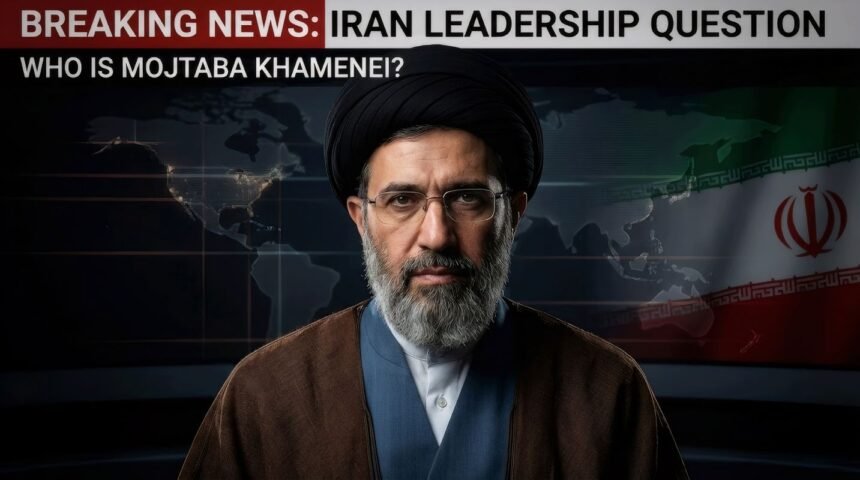
Mojtaba Khamenei, the second son of Iran’s Supreme Leader Ayatollah Ali Khamenei, is increasingly being discussed as a possible successor to his father. As speculation grows about Iran’s future leadership, many analysts believe Mojtaba could play a significant role in shaping the country’s political direction.
Although he has mostly stayed away from the public spotlight, Mojtaba Khamenei has built strong connections within Iran’s religious and political establishments. His ties to influential clerics and the Islamic Revolutionary Guard Corps (IRGC) have further strengthened his position inside the Islamic Republic’s power structure.
Early Life of Mojtaba Khamenei
Mojtaba Khamenei was born in 1969 in Mashhad, one of Iran’s most important religious cities. He is the second-eldest son of Ali Khamenei, who became Iran’s Supreme Leader in 1989 following the death of Ayatollah Ruhollah Khomeini.
Growing up in a politically influential family, Mojtaba witnessed the transformation of Iran after the 1979 Islamic Revolution, which established the country’s current religious-political system.
Military Service During the Iran-Iraq War
In the late 1980s, Mojtaba Khamenei reportedly joined Iran’s military forces, which are linked to the Islamic Revolutionary Guard Corps.
He served during the final phase of the Iran-Iraq War (1980–1988), a conflict that shaped much of Iran’s modern political and military leadership. This experience helped him build relationships with key figures inside the Revolutionary Guards, which remains one of the most powerful institutions in Iran today.
Religious Studies and Clerical Influence
After his military service, Mojtaba moved to Qom, Iran’s major center for Islamic scholarship. There, he pursued religious studies under well-known clerics.
He also taught at a religious seminary, strengthening his connections within the country’s clerical establishment. These ties have helped him maintain influence within Iran’s religious leadership circles.
Despite this influence, Mojtaba Khamenei has largely remained a behind-the-scenes political figure rather than a public leader.
Role Behind the Scenes in Iran’s Leadership
Over the years, Mojtaba Khamenei has reportedly played a significant role in managing the Office of the Supreme Leader.
While he rarely appears in public speeches or official political roles, insiders believe he has had considerable influence in strategic decisions and internal political coordination within Iran’s leadership structure.
His discreet but powerful presence has led many observers to view him as one of the most influential figures in Iranian politics outside formal government positions.
Political Allegations and Controversies
Mojtaba Khamenei first became widely discussed in political circles during the 2005 Iranian presidential election, when conservative candidate Mahmoud Ahmadinejad unexpectedly won the presidency.
Several reformist leaders accused Mojtaba of helping secure support for Ahmadinejad by coordinating with senior clerics and members of the Revolutionary Guards.
At the time, reformist politician Mehdi Karroubi suggested that “a master’s son” had interfered in the election. However, Supreme Leader Ali Khamenei rejected those claims and publicly defended his son.
Could Mojtaba Khamenei Become Iran’s Next Supreme Leader?
In 2024, Iran’s Assembly of Experts reportedly held discussions regarding the future succession of the Supreme Leader.
During that meeting, Ayatollah Khamenei reportedly suggested that his son should not be considered for the position. However, political analysts believe Mojtaba remains one of the most influential figures who could potentially assume leadership.
If Mojtaba Khamenei eventually becomes Supreme Leader, it could mark a controversial moment in Iranian politics.
Some critics argue that a father-to-son succession would resemble hereditary rule, something the 1979 Islamic Revolution aimed to abolish when it overthrew the monarchy of Mohammad Reza Pahlavi.
What It Could Mean For Iran’s Future
Political observers believe that if Mojtaba Khamenei rises to power, it would likely indicate that hardline factions connected to the Revolutionary Guards remain dominant in Iran’s political system.
This could suggest that major policy changes or political reforms in Iran might remain unlikely in the near future.
At the same time, the possibility of such a succession could spark debate and political tension inside the country, especially among groups already critical of the current leadership.
Read Also: Iran News Today (March 2026): Khamenei’s Death Confirmed — What’s Happening Now?
FAQ Section
Who is Mojtaba Khamenei?
Mojtaba Khamenei is the second son of Iran’s Supreme Leader, Ali Khamenei, and a cleric believed to hold significant influence within Iran’s political and religious establishment.
How old is Mojtaba Khamenei?
He was born in 1969 and is currently 56 years old.
Is Mojtaba Khamenei likely to become Iran’s next supreme leader?
Some analysts believe he could be a strong contender, although there has been no official confirmation about succession plans.
What role does Mojtaba Khamenei play in Iranian politics?
He is believed to influence the scenes, particularly within the Office of the Supreme Leader and among clerical and military networks.