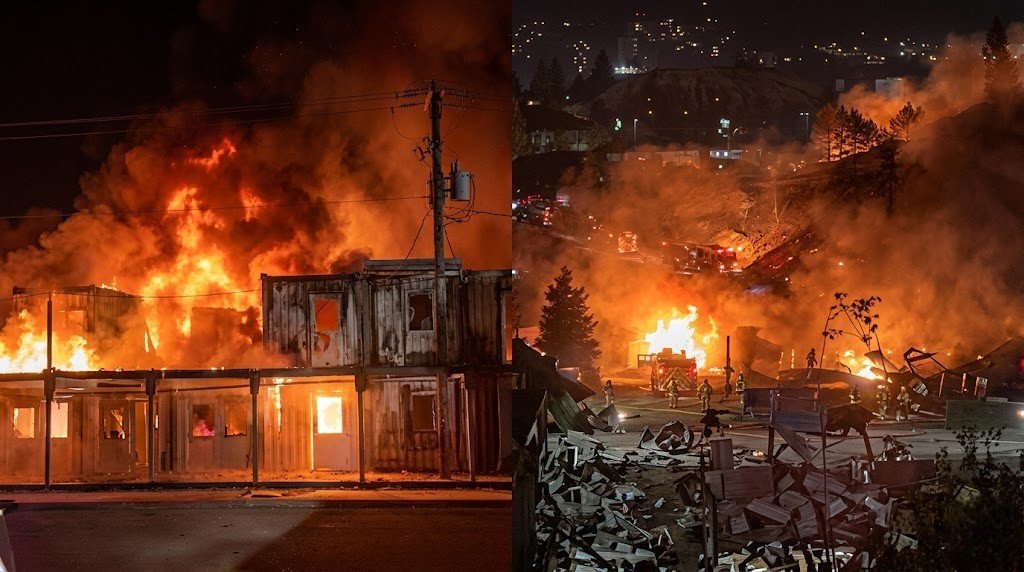
The night of March 16, 2026, was like a nightmare for the city of Kabul again. Suddenly, everything shook. The Afghan government claims that a Pakistani airstrike hit a drug rehabilitation hospital in Kabul. At least 400 people died in this horrific attack—just hearing the number shows how big a tragedy it is.
- What Happened in Kabul on March 16, 2026?
- Was Pakistan involved?—The two sides are completely different
- The impact on the common people of Kabul
- Why have tensions between Pakistan and Afghanistan increased so much?
- How did the world react?
- Why is this incident so important?
- Conclusion
- Frequently Asked Questions (FAQs)
- Why Trust Us?
This one incident has further increased the already existing tension between Pakistan and Afghanistan. Not only these two countries, but the whole world is now watching this incident. Everyone wants to know: What really happened that night?
In this blog, we will simply know what exactly happened in Kabul, who was involved, what Pakistan is saying, how much the common people were affected, and why this incident has become important for the whole world, not just the matter of the two countries.
What Happened in Kabul on March 16, 2026?
Monday night, March 16, 2026. Everything was normal in Kabul at that time—suddenly, the night changed.
At around 9 pm, a terrible airstrike hit the Omar Addiction Treatment Hospital in Kabul. A spokesman for the Taliban government in Afghanistan said that a large part of this huge hospital was destroyed in an instant. You can imagine—a hospital with about 2000 beds, where countless people were receiving treatment, collapsed in one fell swoop.
The most painful thing is that they are not soldiers nor fighters. All of those who were here were receiving treatment to get rid of drug addiction. That is, this blow fell on the most helpless people in society.
According to official estimates, at least 400 people have died, and about 250 have been injured. The number is not just a number—behind each number is a life, a family.
The scene after the incident was like a movie, but in reality it was even more terrifying. Local TV showed security forces pulling people out of the rubble in the dark with torches. Firefighters were trying to put out the fire, while rescue teams battled the flames and searched for bodies in the rubble.
One of Kabul’s largest hospitals was reduced to rubble overnight. And hundreds of unarmed, helpless people lost their lives—which is truly tragic.
Was Pakistan involved?—The two sides are completely different
The biggest question in this whole incident is who actually carried out this attack. And this is where the story gets complicated. Because in Afghanistan and Pakistan, both sides are saying completely opposite things.
Afghanistan’s claim
Afghan government spokesman Zabihullah Mujahid strongly condemned the attack. According to him, Pakistan has once again violated Afghan airspace and directly targeted a drug rehab hospital in Kabul.
He did not stop at just calling it an attack—he said that it was a crime against humanity. Because there was no war going on here, no military base, there were helpless patients.
Other Afghan government spokesmen also said the same thing. According to them, the airstrike took place on the hospital itself at around 9 pm, and a large part of the entire building was destroyed.
All in all, Afghanistan is clearly blaming Pakistan.
Pakistan’s claim
On the other hand, Pakistan has completely denied this allegation.
Pakistan’s Information Minister Attaullah Tarar said that they had actually carried out “precision “airstrikes”—meaning that a very specific target was attacked.
He claimed that the attacks were carried out targeting some military installations and weapons depots in Kabul and the Nangarhar area of eastern Afghanistan.
According to them, these places were where the technical equipment and weapons of the Taliban and anti-Pakistan groups were stored.
Pakistan also says that they did not attack civilian areas in any way; they only hit “military targets.”
So what is the truth?
Now the problem is the two sides are talking completely differently.
- Afghanistan says that a hospital was attacked
- Pakistan says that they only hit military sites
In this situation, an impartial investigation is needed to find out the real truth. But so far that investigation has not been fully completed.
So, at the moment, we are only hearing from both sides, but the real story is still not completely clear.
The impact on the common people of Kabul
We will ultimately know what the investigation reveals. But one thing is clear from the news coming out of Kabul—the real toll of this incident has been on the common people.
Afghan government spokesman Zabihullah Mujahid said that all those who died or were injured were patients of that hospital. He alleged that the hospital and the common people’s places were targeted.
Think about it—these people were not in a war zone. They were sick and admitted to the hospital for treatment. Omar Addiction Treatment Hospital was a large institution with about 2000 beds—a very important place in such a country.
If the Afghan government’s statement is true, then this will be considered one of the most terrible attacks on the common people in recent times.
What is more worrying is that the situation was getting worse even before this major attack. There was an exchange of fire between the two countries in the border area, where at least 4 people were killed—2 of them were children. Moreover, mortar shells struck the village’s houses, injuring 10 people.
In summary, this conflict has ensnared ordinary people in Kabul and its surrounding areas. Some went out to work as usual, some stayed home with their families, and some were receiving treatment in hospitals—but in the end, everyone is paying a heavy price for this situation.

Why have tensions between Pakistan and Afghanistan increased so much?
This incident in Kabul did not happen suddenly in a day. There was a long-standing tension behind it. To understand the real story, we need to go back a little.
How did this conflict start?
This conflict started in late February. Afghanistan alleged that Pakistan had killed civilians by conducting airstrikes inside it. In response, Afghanistan attacked across the border.
Before that, there was a ceasefire, which was brokered by Qatar in October. As a result of that agreement, there was peace for a while. But this peace was completely broken by these new attacks and counterattacks.
In simple terms, one is attacking, and the other is retaliating… and this cycle keeps going. The common people are getting caught in the middle.
What is Pakistan’s main complaint?
Pakistan says that Afghanistan is sheltering its enemy groups. In particular, it keeps mentioning Tehrik-i-Taliban Pakistan (TTP).
They claim that these groups are launching attacks inside Pakistan from Afghan soil, causing casualties among both civilians and security forces.
But Afghanistan completely denies these allegations. According to them, these are not true.
“Open “war”—how dire is the situation?
The most worrying thing is that Pakistan is now saying that it is in an “open war” with Afghanistan.
Such words are not usually used lightly. When two neighboring countries — which already have a lot of history and problems between them — start talking like this, it becomes clear how serious the situation has become.
And this area is already sensitive. There are already organizations like al-Qaeda and the Islamic State, which are trying to become active again.
Who killed how many people? Different claims by both sides
Both countries are giving their own estimates of the losses.
Pakistan’s Information Minister Attaullah Tarar has claimed that they have killed 684 Afghan Taliban fighters.
On the other hand, Afghanistan says that it has killed more than 100 Pakistani soldiers.
But the problem is that there is still no independent reliable information to verify these numbers. It is also very difficult for outsiders to enter the area.
All in all, the situation has now reached a point where it is not just a problem between the two countries but also a growing concern for the peace of the entire region. And the most suffering are the ordinary people, who are not even part of this fighting.
How did the world react?
The world did not remain silent after this incident. Major countries and international organizations quickly started responding.
What did the United Nations say?
The United Nations (UN) spoke directly about the issue. Its Security Council told the Taliban government in Afghanistan that stricter measures must be taken to prevent terrorism.
They also strongly condemned all types of terrorist activities, especially those originating from Afghanistan. At the same time, the term of UNAMA was extended by another 3 months.
An interesting thing is that this decision was taken just a few hours before the news of the hospital attack became public. So many people think that this timing has complicated the whole issue even more.
China’s role
China is quite serious about this situation. They said that their special envoy has been trying to mediate between the two countries for a whole week.
China has directly said that the war needs to stop now.
There is a reason behind this. China shares borders with both countries, and it has major economic interests involved. So if a major war breaks out in this region, not only these two countries but also the entire South Asia and Central Asia could become unstable.
Qatar’s previous role
Qatar had previously tried to bring peace between the two countries. Last October, they helped broker a ceasefire, which brought some calm to the situation.
But that agreement collapsed after renewed fighting broke out at the end of February.
Now everyone is watching—will Qatar come forward again and try to broker a new agreement?
All in all, the world is now taking this situation very seriously. Because this is not just a problem between the two countries—if it becomes a big one, the peace of the entire region could be destroyed.
Why is this incident so important?
Many may think—it’s a problem between two countries, what does it matter to us? But in fact, the matter is not that simple. The impact of this hospital attack in Kabul is not limited to those two countries—it is a much bigger issue.
Is humanitarian law being violated?
There are also rules of war. International humanitarian law clearly states—hospitals or medical facilities can never be attacked.
If the investigation proves that a hospital has indeed been targeted, then this is a very serious violation of the law. And if such incidents happen repeatedly and no one is held accountable in the future, then these rules that protect ordinary people will be weakened.
Peace in the entire region is at risk
Pakistan and Afghanistan share a long border, and it is not fully controlled.
If war breaks out between these two countries, its impact will not stop here.
People will flee their homes (refugee problem will increase)
The economy will suffer
And militant groups may rise again with this opportunity
That is, a problem can gradually spread to many countries.
There is also the nuclear issue
Pakistan is a nuclear-armed country. There may be no direct threat of nuclear war right now, but if such a conflict continues to escalate, there is a risk of the situation getting out of control.
This is why the whole world wants this war not to take a big shape.
The most important thing is the lives of ordinary people
After all, the real issue is people.
It is known that the people who died in Kabul were patients seeking recovery from drug addiction. They were not at fault, nor were they part of any war.
Yet if they have lost their lives in such large numbers, then this is not just news—it is a profound human tragedy.
All in all, this incident reminds us—when a war starts, the people who are actually not on any side suffer the most.
Conclusion
The airstrike on a hospital in Kabul on March 16, 2026—one of the most horrific incidents of the entire conflict—has emerged as one of the most devastating.
Afghanistan says 400 patients died.
Pakistan says they only hit military targets.
It may take some time to fully understand what exactly happened that night.
But one thing is clear now—the situation is rapidly deteriorating. The conflict is escalating, and ordinary people are paying the biggest price. Despite all the international talk to stop the war, there has been little sign of it.
If you follow the news from Kabul—for personal interest, for academics, or to understand South Asian politics—then this is an important issue to keep an eye on. Because this is not just news, it is a situation that could escalate at any time.
Frequently Asked Questions (FAQs)
Q1: What is the hospital that was attacked in Kabul on March 16, 2026?
The name of this hospital is “Omar Addiction Treatment Hospital”. It is a large hospital in Kabul, with about 2000 beds. People are mainly admitted here to recover from drug addiction. The Afghan government claims that a large part of the hospital was destroyed in the airstrike on Monday night.
Q2: How many people are known to have died in this attack?
According to the Afghan government, at least 400 people have been killed and about 250 injured. This information was given by a government spokesman, Hamdullah Fitrat. However, these numbers have not yet been fully independently verified.
Q3: Has Pakistan claimed responsibility for this attack?
No, Pakistan has not directly claimed responsibility for this hospital attack. They said that they carried out airstrikes in the Kabul and Nangarhar areas on March 16, but did not target any hospitals. They claim that all the attacks were on specific military bases and militant infrastructure. They called Afghanistan’s allegations false and misleading.
Q4: Why is there a conflict between Pakistan and Afghanistan now?
Pakistan has accused Afghanistan of harboring groups that have attacked its country—especially the Tehrik-i-Taliban Pakistan (TTP) and some separatist groups.
Afghanistan, on the other hand, says that these allegations are not true.
A ceasefire was brokered by Qatar in October 2025. But the agreement collapsed when renewed attacks began in late February 2026.
Q5: What did the world do after this incident?
The United Nations Security Council unanimously passed a resolution asking Afghanistan to step up counter-terrorism measures. In addition, the term of UNAMA was extended by another 3 months.
China has sent a special envoy to mediate between the two countries. In addition, many countries and organizations have called for an immediate ceasefire.
Q6: Has Pakistan carried out airstrikes in Afghanistan before?
Yes, this is nothing new. In late February 2026, Pakistan also carried out airstrikes inside Afghanistan. In response, Afghanistan attacked across the border.
The previous ceasefire was broken by this counterattack. Several previous clashes have also left many soldiers, civilians, and suspected militants dead.
Why Trust Us?
Our goal is simple — to provide you with accurate, reliable, and truthful information. That’s why we always follow the E-E-A-T guidelines, which Google uses for their content quality. E-E-A-T stands for Experience, Expertise, Authoritativeness, and Trustworthiness.