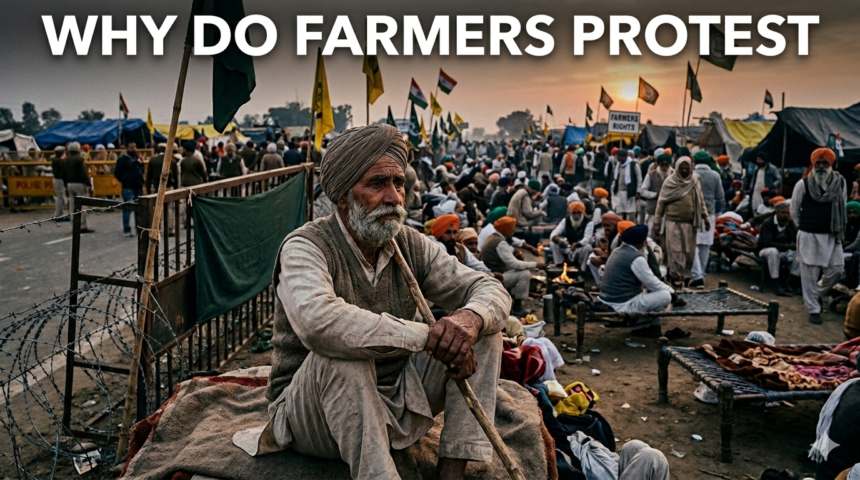
Every few years, you see thousands of farmers sitting on highways, carrying flags, and demanding justice. And every time it happens, two kinds of people show up online — those who support them and those who question them.
But before picking a side, it’s worth asking one honest question — why do farmers protest at all?
The answer is not simple. It is not just about one law or one government. It goes much deeper — into decades of broken promises, failing incomes, rising debt, and a system that was never truly built for the people who feed this country.
Let’s break it down simply.
The Income Crisis — Farming Without Profit
Here is a fact that most people don’t talk about enough — farming in India is not profitable for most farmers.
According to data from the National Sample Survey, the average monthly income of an agricultural household in India is around ₹10,000–₹12,000. That includes income from crops, livestock, wages, and other non-farm sources combined.
Now think about this. A farmer spends money on seeds, fertilizers, pesticides, irrigation, and labor — every single season. If the harvest goes well, he might just break even. If it doesn’t, he goes into debt.
This is the core of the farmer income crisis in India. The cost of cultivation keeps going up every year. But the price farmers get for their produce at the market does not always keep up.
When a farmer grows tomatoes and the wholesale price crashes to ₹1 per kilo, there is no way to recover costs. When onion prices spike in cities, the farmer rarely benefits — the middlemen do.
This is not a one-time problem. It has been happening for decades. And it is one of the biggest reasons why farmers protest in India repeatedly.
The Debate Around Minimum Support Price (MSP)
When you look at the headlines, you might wonder: Why do farmers protest? At the heart of the struggle is a term called Minimum Support Price (MSP). Think of MSP as a safety net—a price floor the government sets for about 23 crops to ensure farmers don’t go bust when market prices crash.
On paper, it sounds like a solid deal. But here’s the catch: MSP isn’t a legal right. It’s more like a suggestion for the private sector. Because it isn’t legally binding, private traders often squeeze small farmers, buying their hard-earned harvest for way less than the official rate. This exploitation is exactly why do farmers protest so passionately. They aren’t asking for a handout; they are asking for a fair, guaranteed price that actually covers their sweat and investment.
For years, the demand has been simple: make MSP a legal guarantee. Farmers want a law that says no one—neither the government nor a private corporation—can buy their produce below that fixed rate. This desperate need for financial security is why do farmers protest for months on end, braving the heat and cold at Delhi’s borders.
The government, however, is hesitant. They argue that a legal mandate could mess with market dynamics or drain the national treasury. While economists debate the numbers, for a family living on the edge of debt, those numbers are a matter of life and death. When the system feels rigged against the person putting food on your table, that is why do farmers protest. Until they feel their livelihood is protected by law, the chants on the streets won’t go silent.
The Farm Laws 2020 Controversy
In September 2020, the Indian government introduced three landmark laws aimed at overhauling the agricultural sector. These reforms were pitched as a way to modernize farming and break the monopoly of traditional, state-regulated wholesale markets known as APMC mandis. On paper, the logic seemed sound: give farmers the freedom to sell directly to private companies, create a structured path for contract farming, and relax storage limits on essential goods. However, if you want to understand why do farmers protest, you have to look past the surface-level “freedom” these laws promised.
To many economists, this looked like a free-market dream, but for the people actually working the land in states like Punjab and Haryana, it felt like a nightmare waiting to happen. The core of why do farmers protest lies in a deep-seated fear of corporate overreach. Farmers worried that if private players could bypass the regulated mandis entirely, those traditional markets would eventually collapse. Without the protection of the mandi system, who would ensure they received the Minimum Support Price (MSP)?
This uncertainty is exactly why do farmers protest so fiercely. They feared a future where massive corporations, with far more legal and financial muscle than a small-scale grower, would form cartels to dictate prices. When a farmer is standing alone against a multi-billion-dollar food conglomerate, they have zero bargaining power. That power imbalance is a major reason why do farmers protest.
The ensuing movement was unprecedented. For 13 long months, thousands of families camped on the highways leading into Delhi, braving the elements to make their voices heard. This historic mobilization showed the world why do farmers protest: it wasn’t just about three specific bills, but about the very survival of their way of life. While the government eventually repealed the laws in November 2021, the victory was only partial.
The fundamental anxieties regarding debt, income security, and a legal guarantee for MSP haven’t gone away. As long as those core issues remain unaddressed, the question of why do farmers protest will continue to be answered by more rallies and demonstrations. They are fighting for a system where they aren’t just cogs in a corporate machine, but respected contributors to the nation’s food security.
Structural Issues — Small Landholdings and Debt
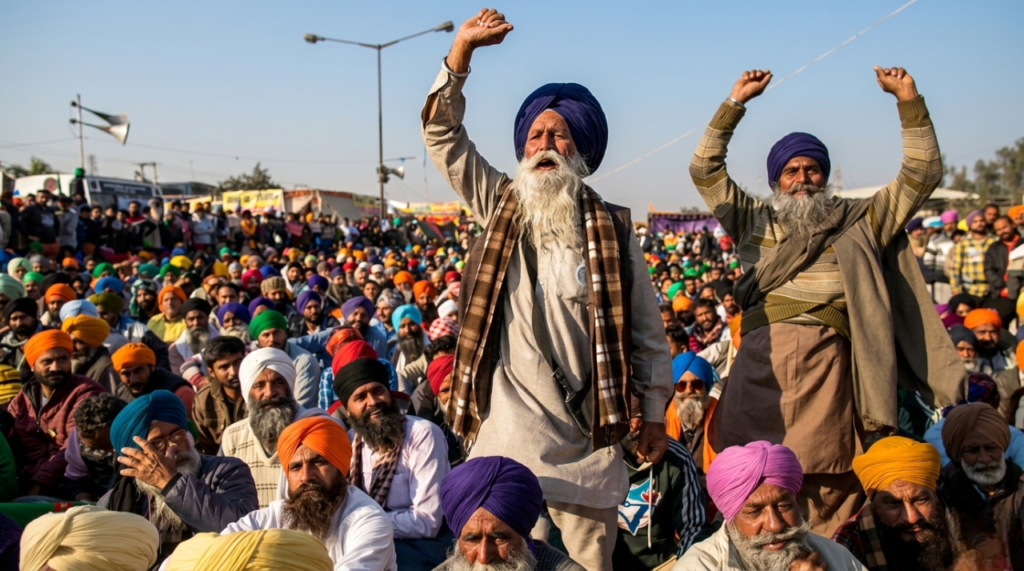
To really understand why do farmers protest, you have to look at the dirt under their fingernails and the debt over their heads. The agricultural crisis in India isn’t just a headline; it’s a systemic trap that has been tightening for decades. Imagine trying to feed a family, pay for school, and run a business on less than two hectares of land. That is the reality for roughly 86% of Indian farmers. When your plot is that small, you can’t afford a tractor or high-tech irrigation. You are at the mercy of the clouds, and that extreme vulnerability is exactly why do farmers protest.
When the rain doesn’t come or a pest destroys the harvest, the spiral begins:
- The Debt Trap: Without formal land documents, many small farmers are locked out of banks. They turn to local moneylenders who charge interest rates as high as 60%.
- A Life Sentence: This isn’t a standard loan; it’s a burden passed from father to son. Families spend generations trying to pay off a single bad harvest. This suffocating cycle is a primary reason why do farmers protest.
- The Ultimate Price: The most tragic answer to why do farmers protest is found in the National Crime Records Bureau data. Thousands of farmers take their own lives every year because the math of survival simply doesn’t add up anymore.
These aren’t individual failures; they are the result of a broken rural economy. When a single bad season means losing your ancestral land to a loan shark, you realize the system is rigged. This sense of being abandoned by the state while being exploited by the market is why do farmers protest with such desperation. They are fighting for a future where a harvest doesn’t lead to a funeral. Until the structural issues of land and credit are fixed, the question of why do farmers protest will continue to be answered on the streets.
Climate Change — The Silent Pressure
To really understand the desperation behind the headlines, you have to look at the sky. While politicians argue over policy, the climate is actively breaking the backs of those who feed us. India’s agriculture is still a gamble on the monsoon, and these days, the house always wins. When you ask why do farmers protest, you have to realize they are fighting a war on two fronts: one against a rigid market and another against an unpredictable planet.
For a small-scale farmer, a single cloud can be the difference between a wedding in the family and a funeral. Climate change isn’t some distant, scientific theory in the rural heartlands; it is a monster that shows up at the front door every season. This environmental instability is a massive reason why do farmers protest today. They are watching their lifelines wash away or wither into dust, and the safety nets promised by the government are often full of holes.
Consider the sheer physical and emotional toll of these climate events:
- The Vanishing Monsoon: When the rains arrive weeks late or disappear in the middle of a growing cycle, the crops simply die in the heat. This uncertainty is exactly why do farmers protest—they cannot plan for a future that changes with the wind.
- The Overnight Disaster: Imagine spending months of back-breaking labor and every rupee you own on a field, only to have an unseasonal hailstorm or a flash flood destroy it all in sixty minutes. This total loss is why do farmers protest for better compensation and faster relief.
- The Debt of Ghost Crops: When a harvest is wiped out by a drought in Maharashtra or Karnataka, the farmer doesn’t just lose the food; they lose the seeds bought on credit and the fertilizers already sprayed. They are left with nothing but a bill they can’t pay, and that mounting debt is why do farmers protest.
Farmers aren’t just complaining about the weather; they are screaming about the lack of a backup plan. When crop insurance schemes turn into bureaucratic nightmares and climate-resilient seeds remain too expensive or unavailable, the feeling of being abandoned becomes overwhelming. That sense of being invisible to the people in power is why do farmers protest with such organized intensity.
They are demanding a system that acknowledges the new, harsh reality of our warming world. If the government doesn’t provide real protection against the “new normal” of climate chaos, the anger will only grow. This fight for survival in the face of nature’s fury and the state’s apathy is the fundamental reason why do farmers protest.
They are tired of being told to wait for help that never comes while their fields turn into graveyards. Until there is a real, functional plan for climate-resilient farming and guaranteed insurance payouts, the question of why do farmers protest will be answered by thousands of boots on the road to the capital. They aren’t just fighting for a price; they are fighting for the right to survive a world that is increasingly stacked against them.
Is It Just Economic — Or Also Political?
When you see thousands of tractors lining the highways to Delhi, it is natural to ask: is this about the soil or is it about the ballot box? The truth is, you cannot separate the two. To understand why do farmers protest, you have to look at how deep-seated economic pain meets the high-stakes world of Indian politics. While it would be naive to say that political parties don’t try to tap into this massive voting bloc, dismissing the entire movement as a “political stunt” misses the point entirely. The hunger and the debt are not scripted; they are the lived reality of millions, and that is exactly why do farmers protest.
In a country where more than half the population depends on agriculture, the rural vote is the ultimate prize. This creates a complex dynamic that explains why do farmers protest with such organized power:
- The Power of Unions: Farmer unions in India have a century-long history of mobilization. They are skilled at turning individual grief into a collective roar, which is why do farmers protest with such discipline and endurance.
- The Political Shield: Across the spectrum, parties will support a movement when they are in the opposition and ignore it when they are in power. This cycle of broken promises is a major reason why do farmers protest—they have learned that unless they block a road, they won’t be heard.
- The Real Crisis: No amount of “political motivation” can keep a person living in a tent on a freezing highway for a year unless the underlying pain is real. The widening income gap and the lack of a legal MSP are not propaganda; they are documented facts that explain why do farmers protest.
The most honest way to look at this is to admit that both things are true at the same time. Real, systemic suffering creates the fuel, and political actors often provide the spark or the megaphone. But the spark wouldn’t matter if the fields weren’t already bone-dry from neglect. When journalists and economists from all sides agree that the rural economy is in structural distress, you realize that the “politics” is just a layer on top of a very real survival instinct. That instinct is why do farmers protest.
They are caught between a market that doesn’t value them and a political system that only notices them during election season. This feeling of being used as a pawn while their livelihoods crumble is a central reason why do farmers protest. They aren’t just fighting for a candidate; they are fighting for a system that treats them as more than just a vote bank. Until the structural debt and the price uncertainty are fixed, the question of why do farmers protest will continue to haunt every government, regardless of which party is in power. Their presence on the streets is a constant reminder that the heart of the country is still beating, but it is under immense pressure.
Conclusion
When you boil it all down, the question why do farmers protest has a simple, painful answer: because they are the foundation of the country, yet they are the most vulnerable to its cracks. They work the hardest, often under a scorching sun or in freezing rain, only to earn the least. It’s a heartbreaking irony that the people filling our plates often can’t afford to fill their own. This systemic neglect is exactly why do farmers protest.
It’s never just about one single law or a specific season. It is about a cumulative weight that has become too heavy to carry. To understand why do farmers protest, you have to look at the pillars of their struggle:
- The Broken Promise: They were told the system would protect them, but when market prices crash, the safety nets are often nowhere to be found.
- The Invisible Stakeholder: Policies that dictate their entire lives are frequently made in glass buildings far away, without their input. This lack of agency is why do farmers protest.
- The Climate Gamble: As the planet warms, a single unseasonal hailstorm can turn a year of sweat into a pile of debt. This constant fear of ruin is why do farmers protest.
| The Reality | The Consequence |
| 86% own small plots | No bargaining power or scale |
| High-interest debt | Generational poverty traps |
| Unpredictable Monsoons | Total crop and investment loss |
| Lack of Legal MSP | Exploitation by private middlemen |
Ultimately, the reason why do farmers protest is a demand for basic dignity. They aren’t asking for the world; they are asking for a fair price, a bit of security, and a seat at the table. Understanding this doesn’t mean you have to agree with every single slogan, but it does mean acknowledging that no one leaves their home to sleep on a highway for months unless they feel they have no other choice. That desperation is the core of why do farmers protest.
FAQ Section
Q1. Why do farmers protest in India so often? Farmers protest because of long-standing issues like low crop prices, lack of legal MSP protection, rising input costs, heavy debt, and inadequate government support. These issues have not been fully resolved despite multiple government schemes.
Q2. What is MSP and why do farmers want it to be legally guaranteed? MSP (Minimum Support Price) is the government-declared minimum price for crops. Currently, it is not legally binding. Farmers want a legal guarantee so that no buyer — private or government — can purchase their crops below that price.
Q3. Why were the Farm Laws 2020 repealed? The Farm Laws 2020 were repealed in November 2021 after over a year of large-scale protests. Farmers feared that the laws would weaken the APMC mandi system, reduce MSP relevance, and allow large corporations to dominate agriculture.
Q4. What is contract farming in India, and is it good for farmers? Contract farming is when a company agrees to buy crops from a farmer at a pre-decided price. In theory, it reduces price uncertainty. In practice, small farmers often have little bargaining power against large companies, which raises concerns about fair contracts and exploitation.
Q5. How does climate change affect Indian farmers? Climate change causes irregular rainfall, unseasonal frost and hailstorms, floods, and droughts — all of which destroy crops and increase losses. Since most Indian farmers lack adequate crop insurance, climate shocks push them deeper into debt.
Q6. Are farmer protests politically motivated? While political groups do engage with farmer movements, the root causes of protests — income crisis, debt, MSP demands — are real and well-documented. It is important to distinguish between genuine economic grievances and political exploitation of those grievances.
Why Trust This Article?
This article has been written with care, relying on hard data from the NCRB, NSSO, and solid policy research. The goal isn’t to pick sides or push an agenda, but to lay out the facts as they are. This is about taking a complex, often heated issue and making it clear and honest for you. Everything here is backed by documented sources and the reality on the ground—no bias, just the truth.