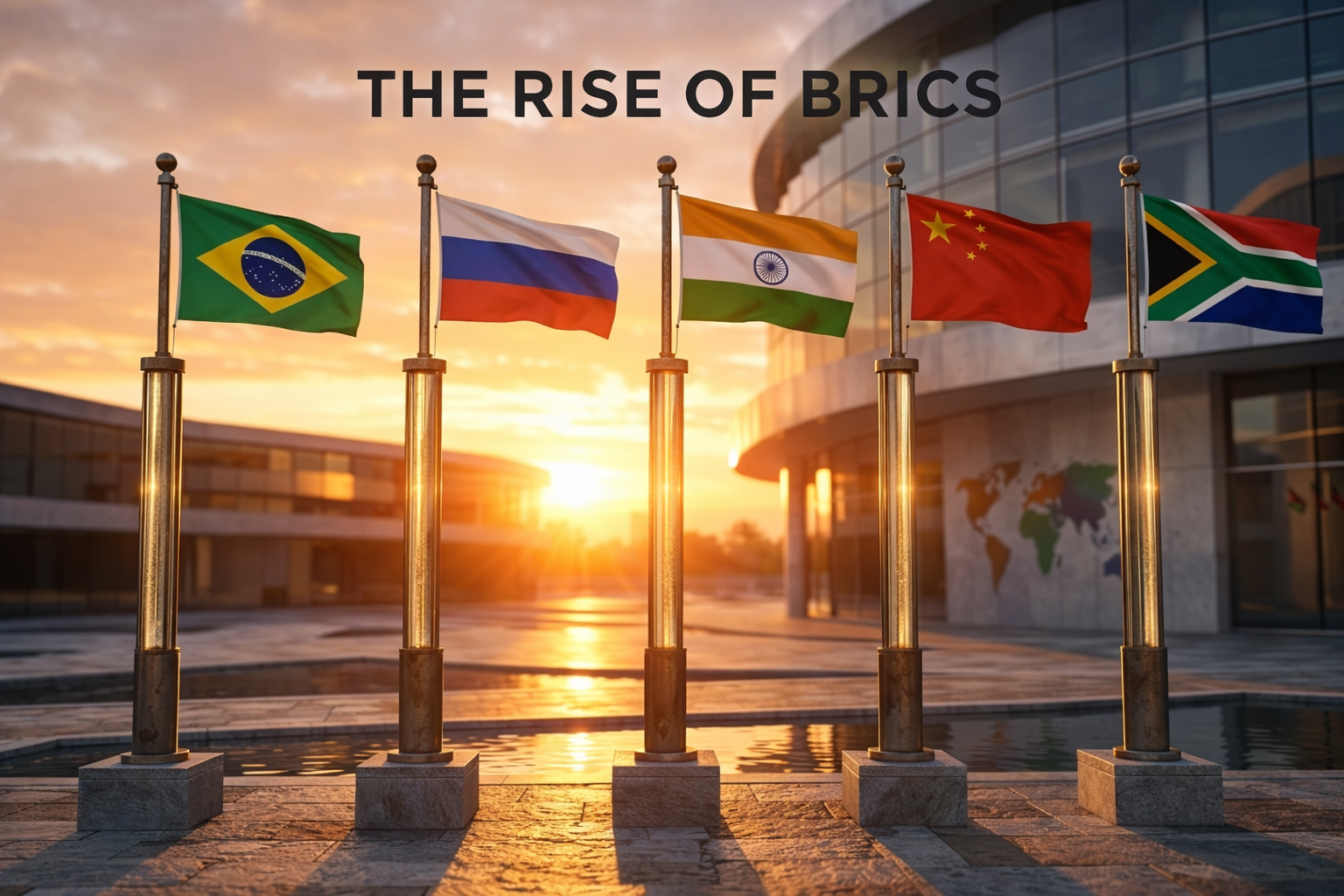
The rise of BRICS is one of the most talked-about topics in international politics and economics today. Whether you follow world news casually or study geopolitics seriously, you’ve probably heard this name come up more and more.
But what exactly is BRICS? Why does it matter so much? And is it really strong enough to challenge the existing global order that the United States and Western nations have dominated for decades?
In this article, we’ll break everything down in simple language — no complicated jargon, no confusing economics terms. By the time you finish reading, you’ll clearly understand what the rise of BRICS means for the world, for trade, and for ordinary people like us.
What Is BRICS?
If you’ve been following world news lately, you’ve probably heard the term BRICS come up more and more frequently.
Politicians mention it. Economists debate it. News anchors discuss it.
But what exactly is BRICS — and why is the rise of BRICS suddenly one of the most important topics in global affairs?
Let’s start from the very beginning.
- B – Brazil
- R – Russia
- I – India
- C – China
- S – South Africa.
The Story Behind It
- How it started: It actually began as a marketing trick. Back in 2001, an economist at Goldman Sachs grouped these countries together to tell investors, “Hey, these places are growing fast—put your money here!”
- The Plot Twist: Eventually, these countries looked at each other and said, “Wait, why don’t we team up for real?”
- The Goal: Even though they are all totally different, they share a common vibe—they want a much bigger seat at the table when it comes to global trade and politics.
Why it matters
What started as a simple investment theory has turned into a serious power move. It’s now a real-deal alliance where these nations work together to shift how the world is run, making it one of the biggest topics in global news today.
The History Behind the Rise of BRICS
To understand the rise of BRICS, we first need to look at the base, the whole thing officially kicked off in 2009 in Yekaterinburg, Russia. Imagine the leaders of Brazil, Russia, India, and China all sitting around one table for the first time. This wasn’t just a polite meet-and-greet; it was a bold statement to the rest of the world. They were essentially saying, “The old way of doing things doesn’t work for us anymore. We’re tired of being sidelined, and we want a world order that actually reflects who we are.”
Gaining Confidence
As the years rolled by, the group stopped being a “theory” and started being a real force. They didn’t just meet once and call it a day; they started holding these massive annual summits and syncing up their votes at the United Nations.
They also started leaning on big institutions like the IMF and the World Bank, basically demanding that these “old guard” organizations stop acting like it’s still 1950. They wanted reforms that gave developing nations more power over their own financial futures. It was about standing up and saying, “Our economies are huge now—treat us like it.”
The 2023 Turning Point
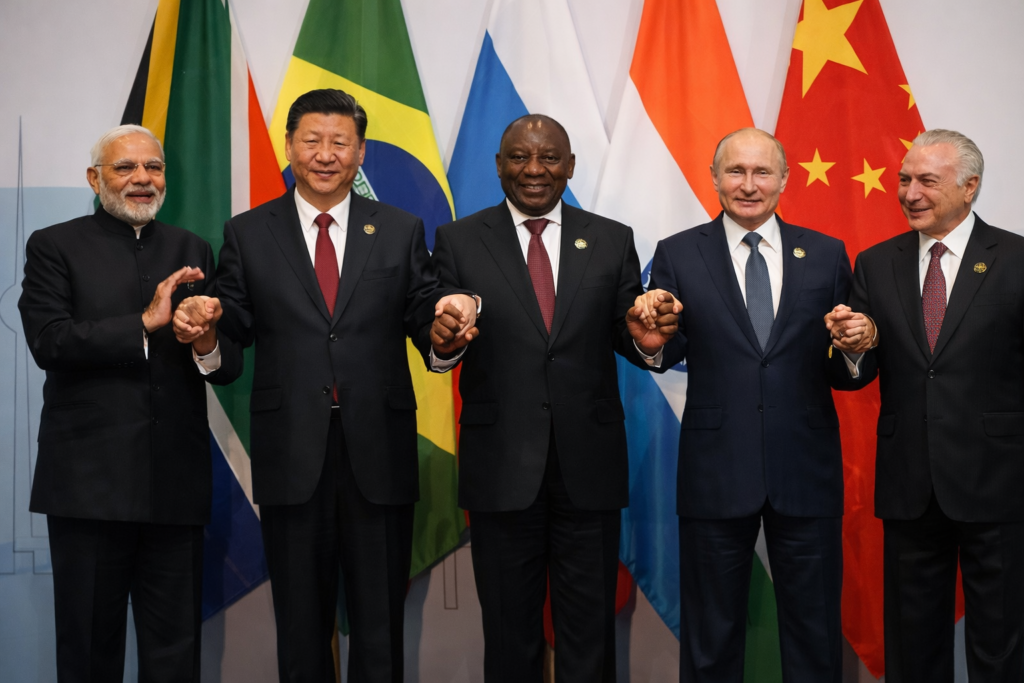
Then, everything changed at the 2023 summit in Johannesburg. This was the “mic drop” moment for BRICS. They didn’t just talk about growing; they actually did it by inviting six new countries to join the club. It was a massive signal to the globe that BRICS expansion wasn’t just some “maybe” or a “someday” plan. It was happening in real-time. It turned the group from a small, exclusive club into a massive, global alliance that the world can no longer ignore.
Why Is the Rise of BRICS Important?
Here’s the thing — BRICS isn’t just a political club. When you look at the raw numbers, the rise of BRICS starts to make a lot of sense.
By population and land:
- BRICS nations cover about 26% of the world’s land area
- They represent over 40% of the global population
By economy:
- BRICS countries collectively account for roughly 26% of global GDP (in nominal terms)
- In purchasing power parity (PPP) terms, BRICS already surpasses the G7
These are not small numbers. When a group of countries representing nearly half the world’s population decides to act together, the global power shift becomes real — not just theoretical.
Beyond the numbers, the rise of BRICS matters because it represents a growing frustration among developing nations with the current global system. Many of these countries feel that Western-led institutions like the IMF, the World Bank, and even the United Nations Security Council don’t truly represent their interests.
BRICS offers an alternative — or at least the promise of one.
BRICS Expansion: Who Are the New Members?
The rise of BRICS isn’t just about economics — it’s about political representation for billions of people who feel unheard in current global institutions. The 2023 Summit in Johannesburg wasn’t just another meeting—it was a massive landmark moment for the group. This was the point where they stopped talking about growing and actually pulled the trigger. They officially invited six new countries to join the club: Saudi Arabia, Iran, Ethiopia, Egypt, Argentina, and the United Arab Emirates (UAE).
Now, there was a bit of a plot twist with Argentina. After a change in their government, they actually decided to decline the invite, but the rest of the group moved forward. This new, expanded version is often called “BRICS+,” and it’s a total game-changer.
Why the New Members Matter
The BRICS expansion isn’t just about adding names to a list. Every new member brings something strategically important to the table. When you look at this list, it’s not just a random collection of names. We’re talking about some of the world’s biggest oil producers, countries with massive populations, and nations that sit right on the world’s most important trade routes.
The fact that Saudi Arabia and the UAE wanted in is arguably the biggest deal of all. For decades, these two have been incredibly close “BFFs” with the United States. Seeing them show up at the BRICS table is a huge signal to the world. It shows a clear shift in global loyalty—even traditional Western allies are starting to look around and realize they need to diversify their friendships and explore new partnerships.
A Loud Message to the World
This expansion sent a “read-between-the-lines” message to the rest of the globe: The alliance of emerging economies is no longer a side project. It’s growing, it’s gaining serious momentum, and more and more countries are lining up because they want a piece of what BRICS is building. It’s not just about trade anymore; it’s about a group of nations deciding they want to write their own rules for the future.
De-dollarization: A Real Threat to the US Dollar?
One of the biggest conversations surrounding the rise of BRICS is the push for de-dollarization. This is probably the “meat” of the whole BRICS conversation, and it’s where things get really interesting. When people talk about de-dollarization, they’re talking about a massive power struggle over the world’s wallet.
The Dollar’s “Superpower” Status
Right now, the U.S. dollar is essentially the world’s “reserve currency.” To put that in human terms: it’s the default language of money. If Thailand wants to buy oil from Norway, they don’t usually use Baht or Krone—they use U.S. dollars.
This gives the United States an incredible amount of “home-field advantage.” Because everyone needs dollars to trade, the U.S. can effectively flip a switch and cut a country out of the global financial system using sanctions. They can influence economies thousands of miles away just because they control the currency everyone is forced to use.
Why the Push for Change?
For countries like Russia and China, this feels like a leash they’ve been trying to break for years. The volume on this conversation got way louder after 2022. When Western sanctions hit Russia following the Ukraine conflict, the rest of the BRICS nations saw how quickly a country could be “unplugged” from the dollar-based system. It was a wake-up call that said: “If it happened to them, it could happen to us.”
What’s Actually Happening on the Ground?
The BRICS nations aren’t just complaining; they’re actually testing out new ways to do business:
- China and Russia are already doing a massive chunk of their trading using Yuans and Rubles instead of dollars.
- India and Russia have been looking into using the Rupee for their deals.
- Brazil’s President Lula hasn’t been shy about it—he’s gone on the record calling for the world to find an alternative so they aren’t tied to the U.S. financial system.
- There’s even been talk about BRICS creating its own shared currency, though that’s still a “maybe” and would be incredibly hard to actually pull off.
Reality Check: Is the Dollar Dying?
Let’s be real—the dollar isn’t going to disappear overnight. It’s baked into the DNA of global banking, and there isn’t another currency yet that is as stable or as trusted worldwide. Most experts will tell you that a total “collapse” of the dollar is highly unlikely in the near future.
But—and this is a big “but”—we are seeing a gradual shift. Even if countries only move 10% or 20% of their trade away from the dollar, it changes the balance of power. It could lead to a world where trade, inflation, and financial markets look very different than they do today. It’s a slow-motion earthquake that could reshape the global economy for the next century.
The New Development Bank: A Real IMF Alternative?
When people talk about the rise of BRICS, they often focus on big speeches and political drama, but the New Development Bank (NDB) is where the rubber actually meets the road. Launched in 2015 and based in Shanghai, this bank is arguably the group’s most “real-world” achievement.
Building a Different Kind of Bank
Think of the NDB as a massive construction fund for the future. Its whole mission is to bankroll the “bones” of a country—the roads, bridges, clean energy grids, and water systems that actually allow an economy to grow.
But why bother starting a new bank when the world already has the World Bank and the IMF?
For decades, if a developing country needed a billion dollars to build a dam or a highway, they had to go to those Western-led institutions. The problem? That money usually came with a long list of “strings attached.” These organizations are largely run by the U.S. and Europe, and they often demand that a country change its internal laws or economic policies before they’ll hand over a cent.
The NDB “Vibe”
The NDB was designed to be the “anti-IMF.” It offers a totally different experience for a country looking for a loan:
- No Political Strings: They don’t try to tell a government how to run its country in exchange for a loan. It’s strictly about the project.
- True Equality: In the old system, the biggest donors usually get the most votes. At the NDB, the founding members actually have equal voting rights. Nobody gets to be the “boss” of everyone else.
- Laser Focus: They are obsessed with infrastructure in the “Global South”—places that have historically been overlooked by big Wall Street banks.
- Independent DNA: It operates completely outside the Western financial system, which means it’s shielded from the usual political pressures.
Why “Options” Equal Power
The bank isn’t just a small club anymore. It’s been growing steadily, bringing in new members like Bangladesh, Egypt, the UAE, and Uruguay. Now, let’s be clear: the NDB isn’t about to put the World Bank out of business tomorrow. It’s still smaller and younger. But for a developing nation, just having a second option is a massive power move. It means they aren’t forced to accept whatever deal the West offers them.
It represents a real shift toward a new global financial “architecture.” For the first time in modern history, there’s a legitimate alternative for countries that want to grow on their own terms. Even if it’s not a full replacement yet, it’s a huge step toward a world where one side doesn’t hold all the keys to the vault.
BRICS vs G7: Is a New Rivalry Taking Shape?
Is BRICS becoming a real rival to the G7 — or is it just political noise?
The honest answer? It’s more real than most Western media wants to admit. And understanding the BRICS vs G7 dynamic is key to understanding the entire rise of BRICS story.
The G7 — made up of the US, UK, Canada, France, Germany, Italy, and Japan — has long been considered the world’s most powerful economic club. These nations set the tone for global economic policy, trade rules, and financial regulations.
But the BRICS vs G7 dynamic is shifting in interesting ways.
Here’s a quick comparison:
| Metric | BRICS (original 5) | G7 |
|---|---|---|
| Population share | ~42% | ~10% |
| Land area | ~26% | ~16% |
| GDP (PPP) | ~31% | ~30% |
| Oil production | Major share (esp. Russia, Brazil) | Limited |
When BRICS expands to include Saudi Arabia, UAE, and others, the energy and economic weight becomes even more significant.
However, it’s important to be realistic here. The BRICS vs G7 framing can be misleading. BRICS is not a military alliance like NATO. It doesn’t have unified foreign policy. India and China, two of its biggest members, actually have border disputes and significant tensions with each other.
Still, even without perfect unity, BRICS represents a collective voice for the Global South — and that voice is getting louder.
What Does a Multipolar World Order Actually Mean?
You’ve probably seen this phrase thrown around a lot lately — especially in discussions about the rise of BRICS.
But what does a multipolar world order actually mean in plain English?
And more importantly — is it good or bad for the world?
Let’s break it down simply, honestly, and clearly.
One Boss vs. a Group Effort
For the last few decades, we’ve essentially lived in a “unipolar” world. That’s just a fancy way of saying there’s been one undisputed heavyweight champion: the United States. Between its military, its massive economy, and the global reach of the dollar, the U.S. has held the most dominant seat at every single table.
A multipolar world would flip that script. Instead of one superpower calling the shots, power would be shared more like a committee. Imagine a world where the U.S., China, the EU, India, and Russia all have roughly equal influence. In this scenario, no single country gets to be the “boss” of everyone else.
BRICS as the Getaway Car
For the BRICS nations—especially the heavy hitters like China, India, and Russia—this group is the vehicle they’re using to drive toward that change. They’re tired of being told what to do by the West and want a global system where developing nations actually have a real vote on global decisions.
Whether a world with five or six “bosses” would actually be more stable is a huge debate among experts. Some think it leads to more balance; others worry it leads to more conflict. But one thing is for sure: the shift is happening. Slowly but steadily, the world is moving away from the “one-superpower” era and toward a future where power is spread out.
Challenges BRICS Still Faces
Despite the impressive rise of BRICS on the world stage, the bloc still faces several serious challenges that cannot be ignored, we have to be real here—as much potential as BRICS has, it’s not all sunshine and rainbows. There are some massive hurdles they have to clear if they actually want to change the world. Here is the honest breakdown:
1. They Don’t Always Get Along
The biggest “elephant in the room” is the relationship between India and China. They have serious border disputes and are constantly competing for influence. When you have a group this big with totally different political systems and goals, it is incredibly hard for them to actually speak with one voice. It’s like trying to get a massive group of friends with different personalities to agree on where to go for dinner—every single night.
2. The Currency Problem
You’ll see headlines about a “BRICS currency” all the time, but most economists think it’s a pipe dream for now. The U.S. dollar isn’t just powerful because of politics; it’s literally the “plumbing” of the global economy. It’s built into every contract and bank account on earth. Replacing that isn’t just a choice—it’s a massive, structural nightmare that won’t happen anytime soon.
3. They’re Still the “Underdogs”
The New Development Bank is a great start, but let’s compare sizes. Compared to the IMF or the World Bank, the NDB is still the “new kid on the block.” It simply doesn’t have the same amount of cash or global reach yet to fully replace the old systems.
4. Totally Different Values
BRICS is a mix of big democracies (like India, Brazil, and South Africa) and authoritarian governments (like Russia and China). Because they run their countries so differently, they often clash when trying to agree on what “shared values” actually look like.
5. The West is Hitting Back
The U.S. and the G7 aren’t just sitting around watching this happen. They are actively strengthening their own alliances and fixing their supply chains to make sure they stay ahead. The “old guard” is definitely putting up a fight to keep their spot at the top.
Conclusion
The rise of BRICS is easily one of the biggest stories of our century. It’s a real-deal push by emerging countries to shake up a power structure that the West has owned for generations.
Is BRICS going to destroy the G7 or kill the dollar overnight? No. Anyone saying that is overhyping it.
But is it creating actual alternatives and giving developing nations more choices? Absolutely. Between the expansion, the new bank, and the talk about moving away from the dollar, it’s clear the world is shifting toward a “multipolar” setup where power is shared.
Whether BRICS eventually thrives or falls apart under its own weight, it has already changed the global conversation. And in world politics, changing the conversation is the first step to actually changing the world.
Frequently Asked Questions (FAQs)
BRICS: The Quick Cheat Sheet
Q1. What does BRICS stand for? It’s an acronym for Brazil, Russia, India, China, and South Africa. Think of it as a club for the world’s biggest “rising stars” who want more say in how the global economy is run.
Q2. Is BRICS more powerful than the G7? It depends on how you measure “power.” BRICS actually has more people, more land, and—recently—a larger share of the world’s economy when you adjust for the cost of living (PPP). However, the G7 (the U.S. and its allies) still wins on raw wealth, tech innovation, and control over global banks.
Q3. What’s “de-dollarization” all about? It’s the push to stop using the U.S. dollar for everything. Currently, the dollar gives the U.S. massive “remote control” over other countries’ finances (like through sanctions). BRICS members, especially China and Russia, want to trade in their own currencies so they aren’t so vulnerable to Washington’s decisions.
Q4. Who joined the club after 2023? The group officially invited Saudi Arabia, Iran, Ethiopia, Egypt, and the UAE. Argentina was invited too, but they backed out after a change in leadership. Adding these countries—especially the oil giants—gave the group a massive boost in energy and political weight.
Q5. What is the New Development Bank? Based in Shanghai, this is the BRICS version of the World Bank. It funds huge projects like roads and green energy in developing nations, but without the “preachy” political conditions that Western banks often demand.
Q6. Will there be a “BRICS Dollar”? Probably not anytime soon. While they talk about a shared currency to dodge the U.S. dollar, it’s incredibly hard to do. Their economies are just too different, and they don’t have a single “Central Bank” to manage it all.
Why Trust This Article?
This article is built on verified data from the World Bank, IMF, and official summit reports. We follow Google’s E-E-A-T standards to ensure our info is expert-level and trustworthy. Our goal is to stay neutral and factual, not political. We keep things updated so you’re always getting the latest, most accurate scoop on global shifts.