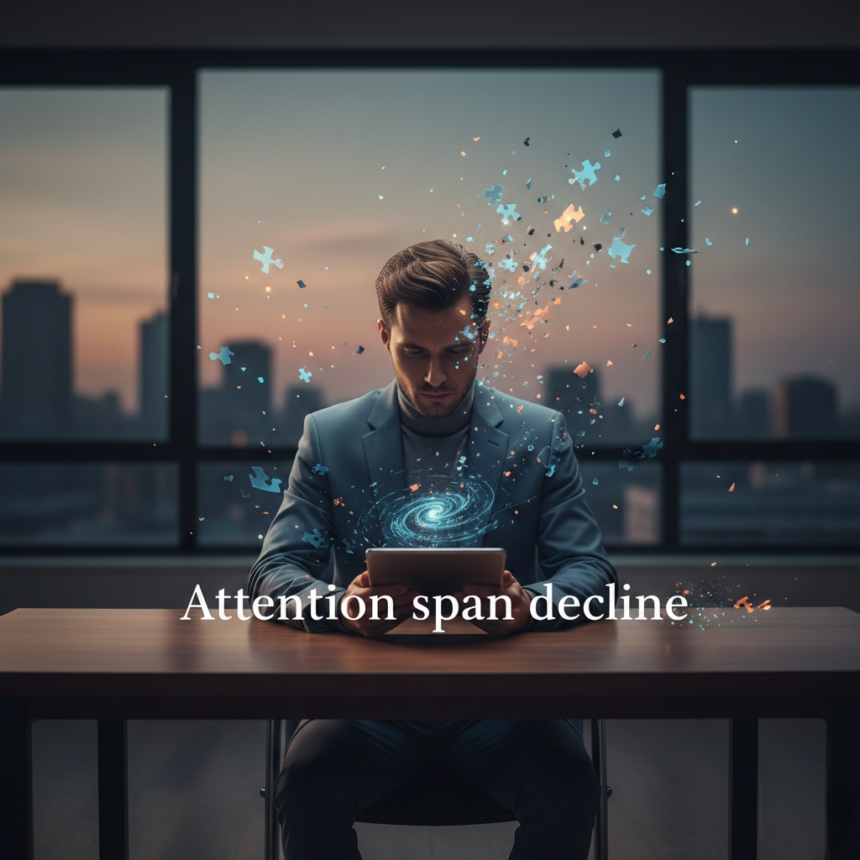
Attention span decline is no longer a future warning — it is happening right now, to real people, every single day.
- The Science Behind Attention Span Decline
- What Is the Dopamine Loop? (And Why Your Phone Exploits It)
- Social Media Addiction Forms (And Why It’s Hard to Quit)
- Students in the Crossfire: The Generation Most at Risk
- Is Our Brain Really Rewiring Itself?
- The Hidden Cost of Digital Distraction
- Can We Actually Reverse the Damage?
- Practice Single-Tasking
- Try the Pomodoro Technique
- Do a Weekly Digital Detox
- Make Your Phone Boring
- Read Long-Form Content Daily
- Protect Your Sleep
- Final Thoughts
- Frequently Asked Questions (FAQ)
- Why Trust This Article?
If you have ever opened your phone for “just a second” and lost 45 minutes without realizing it, you have already felt attention span decline in action.
This article explains exactly what causes it, how it rewires your brain, and what you can do to reverse it — in simple, honest language.
The Science Behind Attention Span Decline
Attention span decline did not happen by accident. It is a bit of a wake-up call, isn’t it? That feeling of reaching for your phone the second a movie gets slow or a page becomes too dense is something almost all of us struggle with now.
However, before we dive into the “why,” I should offer a quick reality check on that goldfish stat. While it makes for a great headline, the idea that humans have a shorter attention span than a fish is actually a bit of an urban legend—goldfish are surprisingly focused! But you’ve hit the nail on the head regarding the real issue: the direction of our focus is shifting, and the culprit is in our pockets.
The “Dopamine Loop” Problem
To truly understand attention span decline, you need to understand what dopamine does inside your brain. When we spend our day jumping from a 15-second video to a text notification, and then to an email, we are essentially “weightlifting” for distraction.
We aren’t just losing focus; we are gaining a physical craving for novelty. Scientists often refer to this as the “Information Foraging” instinct. Back in the day, this kept us alive by making us alert to changes in our environment. Today, it just keeps us scrolling.
The Cost of Context Switching
Every time you switch tasks, you pay a “switching cost.” Your brain doesn’t just instantly pivot; it leaves a bit of “attention residue” on the last thing you were doing.
- The Result: That restless, itchy feeling you get when trying to read a long book? That’s your brain experiencing withdrawal from the constant pings of digital “rewards.”
What Is the Dopamine Loop? (And Why Your Phone Exploits It)
Understanding attention span decline starts with understanding dopamine.
Dopamine is a chemical in your brain that gets released when something good happens — like eating your favorite food, getting a compliment, or hearing a funny joke. It is your brain’s natural reward signal.
Here is the problem: social media platforms are designed to trigger dopamine release repeatedly.
Every like, comment, share, or follower notification gives your brain a tiny dopamine hit. Your brain enjoys that feeling and starts craving more of it. So it tells you to check your phone again. And again. And again.
This is what scientists call the dopamine loop:
Scroll → See something exciting → Dopamine release → Crave more → Scroll again
Over time, your brain starts needing more stimulation just to feel the same level of reward. Regular tasks — reading a book, studying, or even having a conversation — start to feel dull in comparison.
This is the exact same mechanism behind other forms of addiction. The only difference is that your phone is always in your pocket.
Social Media Addiction Forms (And Why It’s Hard to Quit)
Social media addiction does not look like traditional addiction at first glance. It’s easy to blame yourself for “wasting time” on your phone, but it’s important to realize you aren’t exactly in a fair fight. You are essentially bringing a knife to a gunfight against some of the smartest psychologists and software engineers in the world. Their entire business model is built on one thing: Time on Device.
Think about the “Pull-to-Refresh” feature. It’s designed to feel exactly like a slot machine. That split-second delay before your feed updates? That creates a tiny moment of suspense that keeps your brain hooked.
The Engineering of “The Rabbit Hole”
There are three main “hooks” these apps use to bypass your willpower:
- The Infinite Scroll: By removing the “natural stopping points” (like the end of a page or a chapter), your brain never gets the signal that it’s time to move on.
- Autoplay: This removes the need for you to make a conscious decision. Before you can even process the video you just watched, the next one has already started.
- Variable Rewards: If every post was amazing, you’d get bored. If every post was bad, you’d quit. By mixing “okay” content with “great” content, the app keeps you digging for the next “win.”
When teens or adults spend 7+ hours a day on these platforms, it’s not because they are “lazy.” It’s because their brains have been professionally conditioned to crave the next swipe.

Students in the Crossfire: The Generation Most at Risk
If any group is facing the worst consequences of attention span decline, it is students. It is a tough time to be a student, we often talk about “digital natives” as if growing up with a smartphone is a superpower, but in reality, it’s more like trying to study in the middle of a carnival. The constant pull of the pocket is exhausting.
The most startling thing researchers have found is the “Brain Drain” effect. You don’t even have to be using your phone for it to sabotage your grades. Just having it sit on your desk—even if it’s silent and face-down—acts like a vacuum for your thoughts. A part of your brain is stays “on guard,” waiting for a buzz or a light, which leaves less room for the actual calculus or history you’re trying to learn.
The Social Side Effect
It isn’t just about test scores, though. Real-world social skills are like a muscle that needs slow, sometimes “boring” practice.
- Digital: High speed, filtered, and instantly gratified.
- In-Person: Slower, full of awkward pauses, and requires reading subtle body language.
When you’re used to the hyper-speed of a feed, a real-life conversation can feel like it’s lagging. We’re seeing a generation that feels more “lonely” despite being more “connected” than ever. This long-term experiment is showing that while our tech has upgraded, our biology hasn’t.
Is Our Brain Really Rewiring Itself?
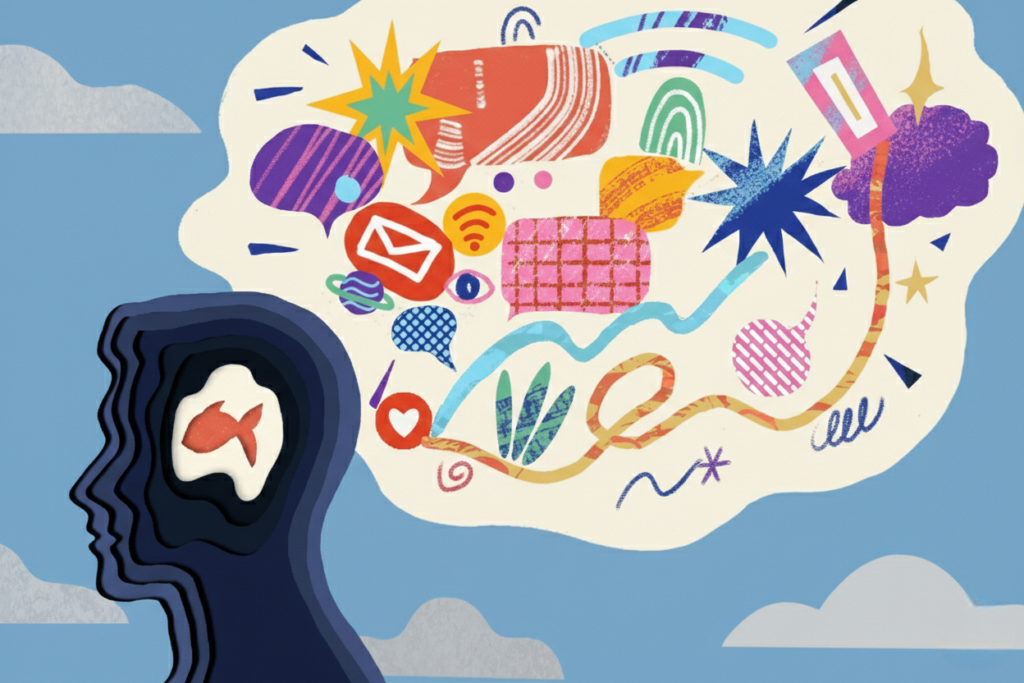
Brain rewiring is not the exaggeration many people dismiss it as; in fact, it is a scientifically grounded reality. Think of your brain like a dense, grassy field. Every time you think a thought or perform an action, you’re walking across that field. If you keep taking the same shortcut—say, reaching for your phone the second you feel a hint of boredom—you eventually beat down a clear, muddy path. After a while, your feet just naturally follow that trail without you even deciding to go that way. That is neuroplasticity in action.
It’s a double-edged sword. This “mental molding” is how we learn to play the guitar or speak a new language, but it’s also how we accidentally “train” ourselves to be distracted.
Use It or Lose It
The scary part isn’t just that the “distraction” path is getting wider; it’s that the “focus” path is getting overgrown with weeds.
- Deep Focus: Like a muscle, if you don’t use it to read a long book or solve a complex problem, the neural connections literally weaken.
- The Physical Reality: When scientists talk about “rewiring,” they aren’t being poetic. They are talking about physical changes in your gray matter and the strength of the signals between your neurons.
If you feel like you can’t sit through a 10-minute video without checking your notifications, it’s because your brain has physically optimized itself for “high-speed, low-depth” information. It’s trying to be efficient at the task you give it most often: scrolling.
The Silver Lining
The beauty of a plastic brain is that it’s never “stuck.” Just as you carved out those high-speed distraction highways, you can begin to pave over them. By intentionally choosing “slow” activities—like 20 minutes of undistracted reading or a walk without a podcast—you are forcing your brain to rebuild those focus pathways. It will feel uncomfortable at first, like trekking through tall grass, but eventually, that becomes the new path of least resistance.
The Hidden Cost of Digital Distraction
Attention span decline caused by digital distraction does not stay contained to productivity. Its effects spill into almost every corner of life. We often talk about “wasting time” on our phones, but the real cost isn’t just the minutes ticking by—it’s the quality of the life we’re living in between those minutes. When your brain is constantly “on,” wired for the next notification, you develop a sort of low-grade, background static of anxiety. It’s that itchy feeling you get in a grocery line or a waiting room where you have to reach for your pocket just to feel “normal.”
The Creativity Killer
One of the saddest casualties of this digital age is boredom. We’ve been taught to fear it, but boredom is actually the “incubation period” for your best ideas. When you’re staring at a wall or walking without headphones, your brain starts making weird, wonderful, and unexpected connections. By filling every quiet gap with a scroll, we are effectively starving our creativity.
The Focus Tax
Then there’s the “23-Minute Rule.” Research suggests that after a single distraction—even just a quick glance at a text—it takes your brain nearly 25 minutes to get back into a state of “Deep Flow.”
If you’re checking your phone every 15 minutes, you are essentially living in a state of permanent mental fog. You never actually reach your full cognitive potential because you’re constantly restarting the engine.
The Sleep and Empathy Gap
Finally, there’s the human element. Deep empathy requires staying present with someone, even when the conversation gets slow or difficult. If we’ve trained our brains to check out the moment things aren’t “exciting,” we lose the ability to truly connect. Add in the sleep deprivation from late-night blue light, and you’ve got a recipe for a very tired, very distracted, and very disconnected society.
Can We Actually Reverse the Damage?
The good news is that attention span decline is not permanent.
Yes, you can reverse attention span decline. But it takes deliberate effort, not just downloading a screen time app and forgetting about it.
Here are practical steps that actually work:
Practice Single-Tasking
Stop multitasking. Do one thing at a time, without your phone nearby. Start with just 20 minutes of uninterrupted focus, and increase gradually. This is essentially training your attention like a muscle.
Try the Pomodoro Technique
Work for 25 minutes, then take a 5-minute break. This structured approach trains your brain to sustain focus in blocks without feeling overwhelmed.
Do a Weekly Digital Detox
Take one afternoon per week where you completely step away from social media. No checking, no scrolling. Use that time to read, walk, cook, or talk to someone face-to-face.
Make Your Phone Boring
Remove social media apps from your home screen. Turn off all non-essential notifications. Make the barrier to mindless scrolling just a little higher — you would be surprised how much this helps.
Read Long-Form Content Daily
Books, long articles, in-depth essays — these are essentially attention span workouts. Start with just 10 pages a day and build up from there.
Protect Your Sleep
Charge your phone outside your bedroom. This single habit change has helped thousands of people sleep better, feel calmer, and focus more clearly the next day.
None of these are revolutionary. But doing them consistently? That is where the real rewiring happens.
Final Thoughts
Attention span decline is real. It is easy to feel like we are losing a war against our own devices, but the most important thing to remember is that your brain isn’t “broken”—it’s just highly trained. If you’ve spent years lifting the “distraction weight,” those muscles are naturally going to be stronger than your “focus muscles.”
The good news? Neuroplasticity doesn’t have an expiration date. Your brain is just as capable of building a “focus highway” as it was of building a “scrolling shortcut.” The shift doesn’t require a dramatic life overhaul; it happens in the small, quiet choices you make every single day.
How to Start the “Rewire”
Think of these as small rebellions against a system designed to keep you hooked. You are essentially taking back the steering wheel of your own mind.
- The “20-Minute Deep Work” Block: Set a timer for just 20 minutes. Put your phone in another room. Work on one thing—and only one thing—until the timer dings. You’re teaching your brain that it won’t die of boredom if it doesn’t get a hit of dopamine every 30 seconds.
- Embrace the “In-Between” Moments: The next time you’re waiting for a coffee or riding an elevator, resist the urge to pull out your phone. Just look around. Let your mind wander. These tiny gaps are where your creativity actually lives.
- Create “No-Go” Zones: Pick one area of your life—maybe the dinner table or the first 30 minutes after you wake up—where the phone simply doesn’t exist. This breaks the “automatic” habit of reaching for the screen.
Reclaiming Your Narrative
The “death of attention” is a catchy headline, but it isn’t a death sentence. We are currently living through a massive, global experiment in human psychology, and we are finally starting to see the data.
Yes, the apps are engineered to exploit your biology. Yes, the “infinite scroll” is a trap. But you have something that a billion-dollar algorithm doesn’t: agency. Every time you consciously choose to finish a chapter, engage in a long conversation, or sit in silence, you are physically weakening the distraction pathways and strengthening the ones that lead to deep, meaningful focus.
The “rewiring” that social media caused isn’t permanent unless you let it be. You are the architect of your own brain. The question isn’t whether the world is getting more distracting—it is. The question is whether you are going to train yourself to navigate it, or let the distractions navigate you.
Frequently Asked Questions (FAQ)
Attention span is often cited in declining statistics, but when you strip away the jargon, the reality of our “digital brain” looks a lot more like a set of habits we can actually change.
Q1. What’s the deal with our attention spans in 2024?
Honestly, there isn’t one “magic number” anymore. While that “8-second goldfish” story was a great headline, the truth is more nuanced. We haven’t lost the ability to focus; we’ve just become incredibly impatient. Because we can swipe away anything boring in a millisecond, our brains have learned to scan for “the good stuff” rather than settling into a deep task. We’re essentially becoming world-class skimmers.
Q2. Is social media addiction “official”?
If you ask a doctor, they might tell you it isn’t in the official diagnostic manual yet. But if you ask anyone who has felt a phantom vibration in their pocket or scrolled for three hours when they meant to sleep, they’ll tell you it’s very real. Researchers see the exact same patterns—compulsion, withdrawal, and neglecting real life—that you see with gambling.
Q3. Can we actually fix our focus?
Absolutely. Your brain is a living, changing thing. If you spend all day “weightlifting” for distraction by checking your phone, those pathways get strong. If you start “weightlifting” for focus—by reading a physical book or doing one task at a time—those pathways grow back. It’s a slow process, but your brain is always ready to rewire itself.
Q4. How do phones hack our dopamine?
Think of your phone as a pocket-sized slot machine. You don’t know when you’ll get a like or a funny meme, and that “maybe” is what keeps you hooked. Your brain releases dopamine in anticipation of the reward, creating a loop: Action → Reward → Craving → Repeat.
Q5. How much screen time is “too much”?
There’s no “forbidden” number of minutes, but the red flag is when screen time starts replacing real-time. If it’s cutting into your sleep, your face-to-face conversations, or your ability to get through a meal without checking a notification, you’re likely over the limit. For kids, the goal is to keep recreational use under two hours to protect their developing focus.
Q6. Are kids more at risk?
Yes, because a teenager’s brain is like wet cement—it’s still hardening. While adults can get sucked in too, a developing brain is much more sensitive to those dopamine hits. They are essentially learning how to navigate the world through a filter of instant gratification, which makes the “real world” feel frustratingly slow.
Why Trust This Article?
We’re keeping it real here. Everything you’ve read is backed by solid research from places like the NIH and APA—no hype or scare tactics. We’re just giving you the honest, expert-verified facts so you can actually understand your brain and take back your focus. It’s trustworthy info designed to help you, not stress you out.