If you’re checking out the Iran news today, you probably already feel that the world looks very different than it did a few days ago. We are seeing what is likely the biggest global shift in years, triggered by a massive joint military strike by the U.S. and Israel on February 28, 2026.
The question everyone is asking in the Iran news today is: Is Ayatollah Ali Khamenei actually gone?
The answer is yes. It has been officially confirmed that he is dead.
This guide covers all the major Iran news today from March 2026. We’ll look at the confirmation of Khamenei’s death, the intense retaliatory strikes coming from Iran, how the rest of the world is reacting, and what this actually means for the future of the Middle East.
Let’s walk through the latest Iran news today step by step.
Has Ayatollah Ali Khamenei Really Died? — The Verified Answer
For several hours after the initial strikes, there was confusion. Iran’s Ministry of Foreign Affairs initially said Khamenei was “safe and sound.” Iranian news agencies Tasnim and Mehr even reported that he was “steadfast and firm in commanding the field.”
But then everything changed.
<mark>On March 1, 2026, Iranian state television — IRIB — officially confirmed the death of Supreme Leader Ayatollah Ali Khamenei.</mark>
He was 86 years old and had ruled Iran since 1989 — a period spanning 36 years, making him the longest-serving leader in the Middle East at the time of his death.
How Did It Happen?
According to multiple verified sources including Al Jazeera, NPR, and NBC News:
- On February 28, 2026, the United States and Israel launched coordinated, large-scale airstrikes across Iran, targeting 24 provinces.
- The CIA had reportedly spent months tracking Khamenei’s location and patterns, identifying a scheduled meeting with senior officials.
- Khamenei was struck while at his office within his compound in Tehran.
- His daughter, son-in-law, daughter-in-law, and grandchild were also confirmed killed in the attack.
US President Donald Trump announced the death on Truth Social before Iranian state media officially confirmed it. Israeli Prime Minister Benjamin Netanyahu had earlier said there were “growing signs” that the supreme leader had been killed.
The Iranian government declared 40 days of national mourning and seven public holidays following the confirmation.
Who Else Was Killed?
The strikes were not just aimed at Khamenei. Israel’s military confirmed the deaths of several top Iranian officials, including:
- Ali Shamkhani — Secretary of the Iranian Supreme National Security Council
- General Mohammad Pakpour — Commander of the Islamic Revolutionary Guard Corps (IRGC)
- Aziz Nasirzadeh — Defense Minister
- Several other military and intelligence officials
US President Trump stated that “48 leaders” had been killed in the operations, calling it a historic success.
What It Means for Iran’s Leadership
This is Iran’s first leadership transition since 1989. The position of Supreme Leader is appointed by the Assembly of Experts, and Khamenei had no officially designated successor.
An Interim Leadership Council Is Being Formed
According to Ali Larijani, secretary of Iran’s Supreme National Security Council, Iran announced the formation of an interim Leadership Council to manage state affairs until a permanent successor is chosen.
The three-member interim council includes:
- Alireza Arafi
- President Masoud Pezeshkian
- Chief Justice Gholam-Hossein Mohseni-Ejei
The IRGC is pushing for a swift appointment of a permanent leader, which is expected to be a highly politically charged process.
What Will Change?
Analysts at the Council on Foreign Relations (CFR) have outlined three possible paths for Iran:
- Regime Continuity — A new supreme leader is installed, and the system continues much as before (“Khamenei-ism without Khamenei”).
- Military Takeover — The IRGC effectively consolidates power.
- Regime Collapse — Sustained strikes and public unrest lead to a fundamental change.
The CFR cautioned that none of these near-term outcomes are likely to bring immediate political or economic improvement for ordinary Iranians.
Iranian President Masoud Pezeshkian called the killing a “great crime” and vowed that it “will not go unanswered.”
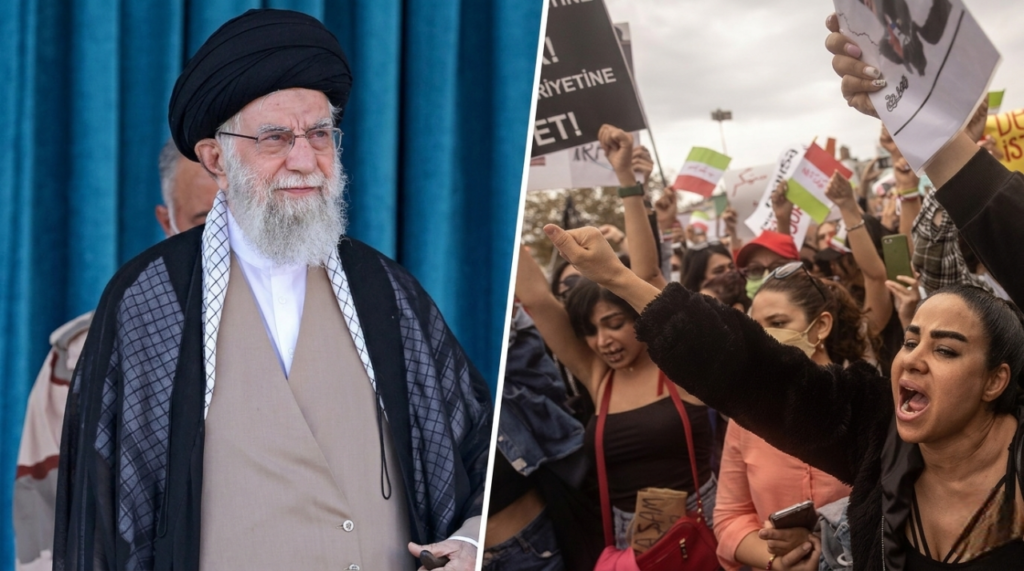
Meanwhile, reactions among Iranians at home were deeply divided. Some took to the streets in cities like Isfahan, Tehran, Shiraz, and Karaj — some celebrating, others mourning. Both reactions were captured on video and widely circulated online.
Regional Conflict and Iran Retaliation Strikes
Iran did not stay quiet. Almost immediately after the strikes began, Tehran launched what it described as its most powerful military response ever.
What Iran Has Struck So Far
The IRGC claimed it was targeting 27 military bases where US soldiers are deployed across the region. According to multiple sources:
- Iran fired 137 missiles and 209 drones toward the UAE on the first day alone.
- Strikes were reported in Dubai, Abu Dhabi, Manama (Bahrain), Doha (Qatar), Kuwait, and Jordan.
- Iran also launched missiles at Israel, killing at least 8 people in Beit Shemesh and injuring around 20 more.
- A fire broke out at a US Navy base in Bahrain following Iranian missile hits.
- Iran struck civilian aviation infrastructure, including international airports in Kuwait and the UAE, forcing flights to be cancelled across the region.
Dubai’s Jebel Ali port — one of the busiest in the world — was hit by Iranian munitions, and the iconic Palm Jumeirah area saw visible smoke rising on the horizon.
For a second day, fresh explosions were reported across Gulf cities, confirming that Iran’s retaliation was ongoing and escalating.
Iran Also Targeted the Strait of Hormuz
One of the most alarming developments: Iran moved to block the Strait of Hormuz, through which roughly one-fifth of the world’s oil supply passes daily. Shipping giant Maersk confirmed it had suspended all Trans-Suez sailings and was rerouting ships around the Cape of Good Hope instead.
This is not a symbolic act — if sustained, it has serious consequences for global oil markets and the wider world economy.
Trump’s Warning
President Trump responded directly on social media: “Iran just stated that they are going to hit very hard today, harder than they have ever hit before. THEY BETTER NOT DO THAT, HOWEVER, BECAUSE IF THEY DO, WE WILL HIT THEM WITH A FORCE THAT HAS NEVER BEEN SEEN BEFORE!”
He also told the IRGC to surrender, offering immunity or warning of “certain death.”

Global Reactions — What the World Is Saying
It’s clear the Iran news today has the entire world on edge. Every major power is weighing in as the situation spirals, and the diplomatic fallout is just as intense as the military one. Here is the breakdown of how the globe is reacting to the Iran news today:
The Global Response
The United Nations UN Secretary-General António Guterres hasn’t held back in the Iran news today. He condemned both the initial US-Israel strikes and the massive retaliation from Iran. Speaking to the Security Council, he warned that these events are a “grave threat to international peace” and pleaded with everyone to step back before things get even worse.
The European Union The Iran news today includes a stern warning from EU foreign policy chief Kaja Kallas. She’s calling for “maximum restraint” to protect civilians and labeled Iran’s strikes on neighboring Gulf countries “inexcusable.” She also pointed out that if this keeps up, the global economy is going to take a massive hit.
Russia and China Both Moscow and Beijing are focusing their part of the Iran news today on criticizing the US and Israel.
- Russia: Dmitry Medvedev accused Washington of using nuclear talks as a smokescreen for this military hit.
- China: The foreign ministry is demanding an immediate end to military actions. However, experts watching the Iran news today note that China is being careful—they want to protect their own regional interests without getting too tangled up in Iran’s defense.
The Gulf States For countries like Saudi Arabia, Qatar, and the UAE, the Iran news today is a matter of immediate national security. They’ve all condemned Iran’s retaliatory strikes on their soil. Saudi Arabia was particularly vocal, calling the attacks “unjustified” because they had already promised Iran they wouldn’t let their airspace be used for the US-Israel mission. Currently, several of these nations have shut down their airspace entirely.
Hezbollah and the Houthis In the more aggressive corners of the Iran news today, Hezbollah has fully pledged its support to Iran and is threatening more fighting. Meanwhile, the Houthis in Yemen have announced they are restarting drone and missile attacks on any US or Israeli ships moving through the Red Sea.
Economic and Geopolitical Impact
This isn’t just about military bases and missiles anymore—the Iran news today shows that the global economy is starting to feel the heat. Here is how these headlines are actually going to hit your wallet and the world market:
The Economic Impact
Oil Prices are Spiking If you’ve looked at the Iran news today, you know the Strait of Hormuz is the world’s biggest oil chokepoint. With navigation there basically paralyzed, energy markets are panicking. This narrow strip of water handles 20% of the world’s oil, and any long-term blockage means prices at the pump are going to climb fast for everyone from the U.S. to India.
Shipping and Trade are Messy One of the biggest stories in the Iran news today is Maersk and other shipping giants officially pulling out of the Suez Canal route. They are now sending ships all the way around the tip of Africa (the Cape of Good Hope).
- The Result: This adds weeks to delivery times.
- The Cost: Shipping prices are skyrocketing, and that extra cost eventually shows up in the price of the groceries and electronics you buy.
Peace Talks are Over For a while, there was hope for a deal. In early 2026, the U.S. and Iran were actually talking about curbing nuclear programs. But according to the Iran news today, those negotiations are dead. The military strikes have wiped out any chance of a diplomatic “fix” anytime soon.
What the Experts Are Saying
The analysts featured in the Iran news today are giving us a reality check:
- Regime vs. Leader: The Council on Foreign Relations (CFR) points out that while Khamenei is gone, the Revolutionary Guard (IRGC) is the actual power structure. Taking out one leader doesn’t mean the whole system collapses.
- Broken Ties: The Asia Group warns that years of trying to build “nicer” relationships between Iran and its neighbors are likely down the drain.
The Iran news today suggests we are entering a very long, very volatile chapter. Would you like me to track the specific changes in Brent Crude oil prices or the latest carrier movements in the Persian Gulf?
Summary / Final Verdict
Here’s a quick recap of everything you need to know about Iran news today:
| What Happened | Key Detail |
|---|---|
| Khamenei’s Death | Confirmed March 1, 2026 by Iranian state TV |
| Who Carried Out the Strike | Joint US-Israeli military operation |
| When It Happened | February 28, 2026 (predawn) |
| Other Officials Killed | Defense Minister, IRGC Commander, and others |
| Iran’s Response | Massive retaliation — missiles and drones across the Gulf |
| Countries Targeted by Iran | UAE, Qatar, Bahrain, Kuwait, Jordan, Israel |
| Interim Leadership | Council of 3 officials formed |
| 40-Day Mourning | Declared by Iranian government |
| Global Reaction | UN, EU, Russia, China — all called for restraint |
| Strait of Hormuz | Disrupted; shipping routes being rerouted |
This is a fast-moving situation. The world is watching what Iran does next — and whether the IRGC, still largely intact, decides to escalate further or seek a path to de-escalation.
FAQ — Your Top Questions Answered
Q1. Is Khamenei’s death 100% confirmed? Yes. Iranian state television (IRIB), the Iranian cabinet, and international outlets including Al Jazeera, NPR, NBC News, and Reuters have all confirmed the death of Supreme Leader Ayatollah Ali Khamenei as of March 1, 2026.
Q2. Who will be the next Supreme Leader of Iran? There is no officially designated successor. An interim Leadership Council made up of three officials — including President Masoud Pezeshkian — has been formed. The Assembly of Experts will eventually appoint a permanent successor.
Q3. Did Iran retaliate after the US-Israel strikes? Yes, massively. Iran launched hundreds of missiles and drones targeting US military assets across the Gulf — hitting the UAE, Qatar, Bahrain, Kuwait, Jordan, and Israel. The attacks are ongoing as of March 2, 2026.
Q4. Is the Strait of Hormuz blocked? The Strait of Hormuz has been disrupted, with shipping companies including Maersk suspending sailings through the route. This raises serious concerns about global oil supply and energy prices.
Q5. What was the reason given by the US for the strikes? President Trump stated the objective was to eliminate Iran’s missile and military capabilities, prevent Iran from obtaining nuclear weapons, and push for regime change. Netanyahu called it removing an “existential threat.”
Q6. Could this escalate into a wider regional or world war? Analysts have warned of serious escalation risks. Several countries — including Hezbollah, the Houthis, and potentially others — have pledged retaliation. The UN has described this as a “grave threat to international peace and security.” Whether it expands further depends on the coming days.
Why Trust This Article?
The Iran news today is honestly mind-blowing. If you’ve been scrolling through your feed, you know the world feels like a different place than it did just a few days ago. Following that massive U.S.-Israeli strike on February 28, the Iran news today has officially confirmed that Ayatollah Ali Khamenei is dead. It’s the end of an era, and the fallout is happening in real-time.
What’s the vibe in the Iran news today? It’s tense. Iran has already fired back with hundreds of missiles hitting targets across the Middle East, and we’re seeing reports of the first U.S. casualties. On top of that, the Iran news today shows the global economy is taking a hit—oil prices are jumping because the Strait of Hormuz is basically a no-go zone right now.
An interim council is trying to keep things from falling apart, but the Iran news today makes one thing clear: we’re in uncharted territory.