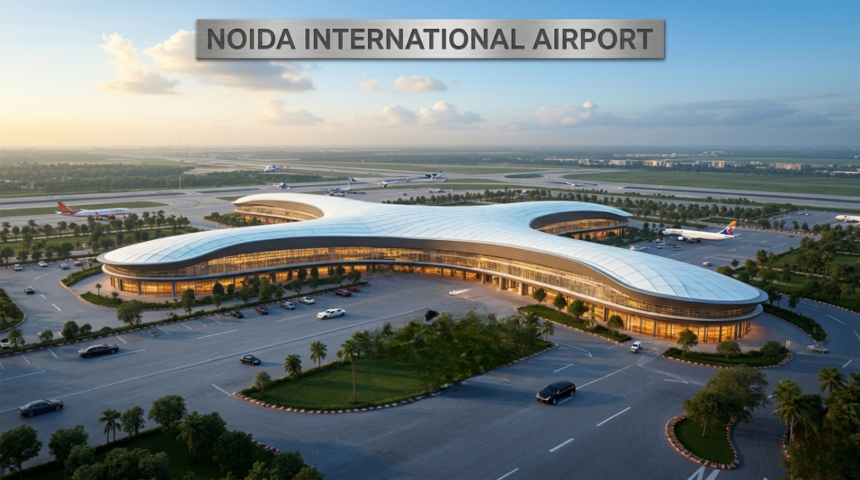
If you have been following infrastructure news in India, you already know that the Noida International Airport is one of the most talked-about projects right now. Located in Jewar, Uttar Pradesh, this airport is not just another terminal building. It is being planned and built to become one of the largest airports in the entire world.
- What Is Noida International Airport?
- Latest News and Opening Updates 2026
- Location and Key Details
- Phase-Wise Development Plan
- Phase 1 – Target Year 2026
- Phase 2 – Target Year 2030
- Phase 3 – Target Year 2034
- Phase 4 – Target Year 2036
- Key Features and Facilities
- Economic and Real Estate Impact
- Challenges and Concerns
- Future Outlook
- Conclusion
- Frequently Asked Questions
- Why Trust This Content
Whether you are a frequent flyer, a real estate investor, a student curious about India’s growth, or just someone who lives in the Delhi NCR region, this airport is going to change a lot of things for you. In this article, we cover everything – from the Noida airport opening date and Jewar Airport 2026 updates to its features, phases, capacity, and what it means for the economy.
Let us get into all the details.
What Is Noida International Airport?
The rise of the Noida International Airport, often called Jewar Airport, marks a massive shift for Northern India. Rising from the fields of Gautam Buddha Nagar in Uttar Pradesh, this greenfield project sits perfectly along the Yamuna Expressway. Its strategic location ensures smooth connectivity for travelers coming from Noida, Agra, and Delhi.
For too long, Delhi’s IGI Airport has shouldered the entire burden of the capital’s soaring flight traffic. Operating well past its intended limits, IGI simply couldn’t keep up with India’s hunger for air travel. The Noida International Airport isn’t just a shiny new addition; it is a vital relief valve for a region that was running out of runway.
The vision is being brought to life by Zurich Airport International AG alongside YIAPL. With heavy backing from the Uttar Pradesh government, the project officially took flight when Prime Minister Narendra Modi laid the foundation stone in late 2021. This isn’t just about adding a few gates; it is about building a global titan.
By the time all four development phases wrap up, the Noida International Airport is projected to stand as India’s largest aviation hub. It is designed to rival the world’s biggest airports, fundamentally changing how millions of people connect with the globe. From local economic boosts to seamless international transit, the Noida International Airport represents a future where the sky is no longer a bottleneck. This project proves that for a growing nation, bold infrastructure is the only way forward.

Latest News and Opening Updates 2026
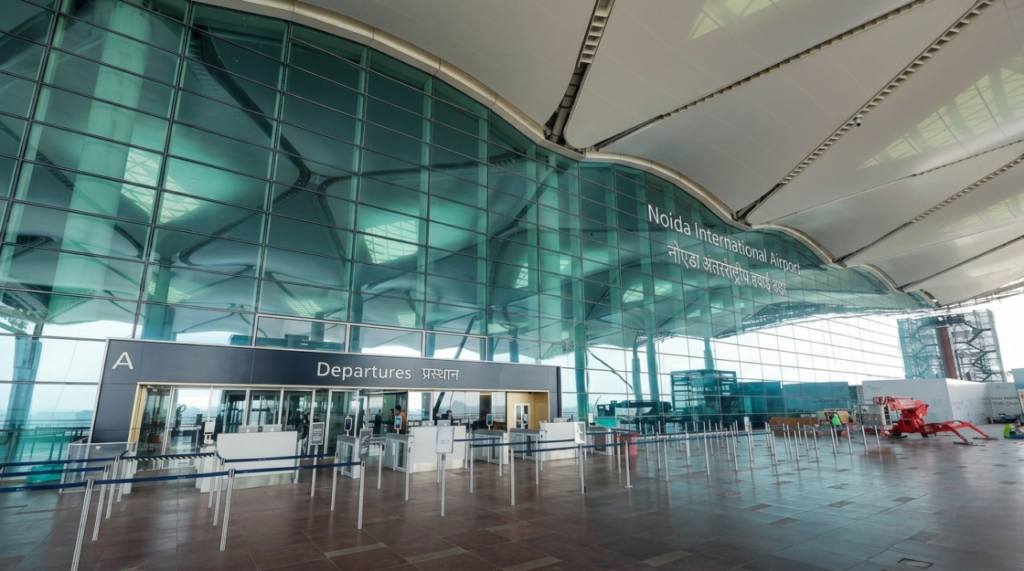
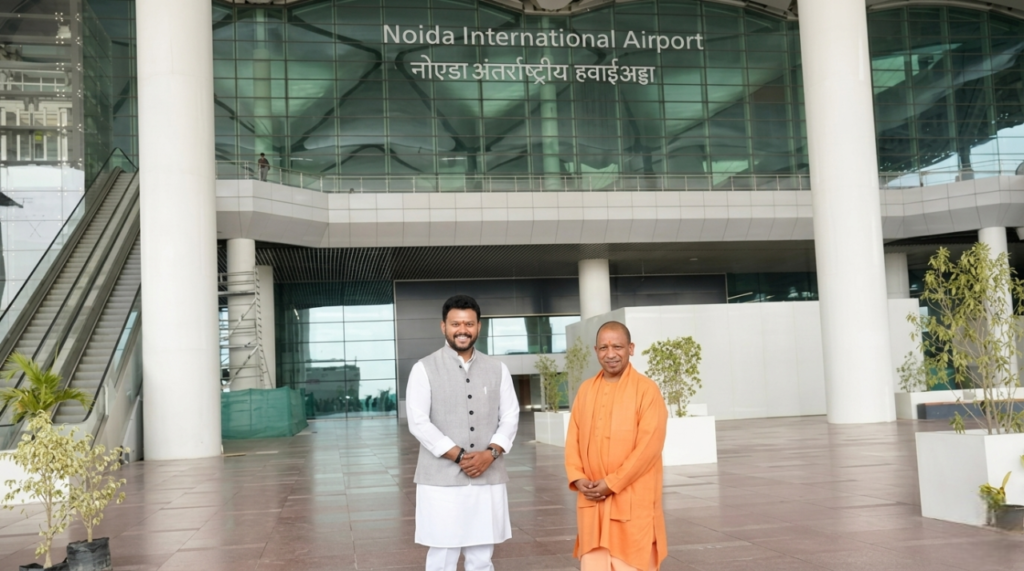
The long-awaited Noida International Airport has finally transitioned from a blueprint to a reality. As of March 28, 2026, the first phase was officially inaugurated by Prime Minister Narendra Modi, marking a historic milestone for Indian aviation. While the ribbon has been cut, travelers are asking the most important question: when can we actually book a ticket?
Commercial flights are expected to take off between mid-April and May 2026. The airport recently secured its aerodrome license and safety clearances, meaning the infrastructure is ready for action. Initial operations will focus on roughly 150 daily flights connecting to 10 major domestic cities, including Mumbai, Bengaluru, and Hyderabad. Major carriers like IndiGo and Akasa Air have already confirmed they will be leading the charge from this new hub.
Getting to the Noida International Airport is also becoming easier. Beyond the direct link to the Yamuna Expressway, a massive 72-km Rapid Rail (RRTS) corridor is in the works to connect the terminal with Ghaziabad and Delhi. For now, a fleet of electric taxis and specialized bus routes are already active to ferry passengers from nearby NCR hubs.
This terminal is more than just a backup for Delhi; it is a tech-forward, net-zero facility designed to handle 12 million people annually right out of the gate. With its launch, the Noida International Airport is officially open for business, ready to redefine how we travel across North India. The wait is over—the engines are warming up.
Location and Key Details
The Noida International Airport is located in Jewar, Gautam Buddha Nagar, Uttar Pradesh. Here are the key location facts and basic project details:
- Location: Jewar, Gautam Buddha Nagar, Uttar Pradesh
- Distance from Delhi: Approximately 72 kilometers
- Distance from Noida City Centre: Approximately 40 kilometers
- Distance from Greater Noida: Approximately 30 kilometers
- Distance from Agra: Approximately 130 kilometers
- Highway Access: Yamuna Expressway (direct access)
- Developer: Yamuna International Airport Private Limited (YIAPL)
- International Partner: Zurich Airport International AG
- Land Area (Total Project): Approximately 5,000 hectares across all phases
- Phase 1 Land: Approximately 1,334 hectares
- Type: Greenfield Airport
The Yamuna Expressway airport connectivity is one of the strongest points of this project. The expressway already connects Delhi to Agra efficiently, and having an international airport along this route makes it a central hub for the entire belt. People traveling from Mathura, Vrindavan, Agra, or even parts of Rajasthan will find this airport far more convenient than traveling all the way to Delhi’s IGI Airport.
Phase-Wise Development Plan
The Noida International Airport is being developed in four phases. Each phase adds capacity and infrastructure to the airport. Let us look at each phase in detail.
Phase 1 – Target Year 2026
Phase 1 is the foundation of the entire project. This is the phase that will open the airport to the public for the first time.
Key highlights of Phase 1:
- One functional runway
- One integrated terminal building
- Passenger handling capacity of approximately 12 million passengers per year (MPPA)
- Modern check-in, security, and boarding infrastructure
- Cargo handling facilities
- Basic retail, food, and commercial areas within the terminal
The Phase 1 investment is estimated at over Rs 10,000 crore. The terminal design is being built with passenger comfort and efficiency in mind. Architects and planners are working to make it both functional and visually impressive.
The Noida airport flights start date is expected to be in 2026. This is the official target shared by the project stakeholders. Once Phase 1 is operational, travelers from Noida, Greater Noida, Agra, Mathura, and surrounding regions will have a dedicated airport closer to home.
Phase 2 – Target Year 2030
Once Phase 1 is up and running and the airport proves its demand and capacity, Phase 2 will kick in.
Key additions in Phase 2:
- A second runway
- Expanded terminal capacity
- Total passenger handling capacity to increase to approximately 30 million passengers per year
- Enhanced international flight connectivity
- More cargo and logistics infrastructure
- Additional commercial zones
By the end of Phase 2, the Noida International Airport will be competing directly with Indira Gandhi International Airport in terms of passenger traffic. This is when the airport truly steps into its role as a major aviation hub.
Phase 3 – Target Year 2034
Phase 3 takes things even further. At this stage, the airport will have:
- A third runway
- Another terminal expansion
- Total passenger capacity rising to approximately 50 million passengers per year
- Enhanced multimodal connectivity infrastructure
- Expansion of business and cargo facilities
- Upgraded amenities and airport city development in surrounding areas
By Phase 3, the Jewar Airport will be one of the busiest airports in Asia by passenger volume. This phase is when the surrounding Jewar region is expected to see a full airport city emerge with hotels, logistics parks, commercial districts, and residential zones.
Phase 4 – Target Year 2036
Phase 4 represents the full completion of the Noida International Airport project as originally envisioned.
Phase 4 targets:
- A fourth runway
- Final terminal expansions
- Total capacity reaching approximately 70 million passengers per year
- Full airport city development
- World-class cargo and logistics hub status
- Complete integration with regional mass transit systems
At this stage, the Noida International Airport will stand as one of the largest airports in the world by passenger capacity. It will not just be an airport – it will be an economic zone, a business destination, and a city in itself.
Key Features and Facilities
The Noida International Airport is a masterclass in modern engineering, designed to reset the bar for global travel. From day one, the facility is built for speed and scale. The massive 3,900-meter runway is already equipped to handle the world’s largest wide-body aircraft, ensuring that long-haul international flights can operate without a hitch. By the time the final expansion wraps up, the airport will boast multiple runways, allowing planes to land and depart at the same time to virtually eliminate those frustrating tarmac delays.
The terminal itself is a digital marvel. Forget standing in long lines; the Noida International Airport uses biometric “DigiYatra” face-scanning and automated bag drops to whisk you from the entrance to your gate in record time. It is India’s first net-zero airport, powered by massive solar farms and designed to recycle every drop of water it uses.
Beyond the flights, this is a logistics powerhouse. A massive cargo hub and an on-site aircraft repair center make the Noida International Airport a magnet for global business. It’s even being connected to the national freight corridors and a 72-km high-speed rail link to Ghaziabad and Delhi. Surrounding the gates, a massive “Airport City” is rising, featuring luxury hotels, shopping districts, and business parks. Every detail of the Noida International Airport is crafted to be more than just a transit point—it is a sustainable, high-tech engine for the future.
Economic and Real Estate Impact
The economic impact of the Noida International Airport goes far beyond just aviation. Here is why this project matters for the wider region:
Employment Generation: The airport alone is expected to generate hundreds of thousands of direct and indirect jobs across aviation, hospitality, logistics, retail, security, and maintenance sectors. When the airport city develops fully, employment numbers could reach into the millions.
Boost to Noida and Greater Noida: The proximity to the airport is already driving investment into Noida and Greater Noida. Companies are setting up offices, warehouses, and facilities in anticipation of the airport opening.
Real Estate Growth in Jewar: The real estate market around Jewar has already seen significant price appreciation. Residential plots, commercial properties, and industrial land near the Yamuna Expressway corridor have attracted investors from across India.
Industrial and Logistics Growth: The combination of Yamuna Expressway, Dedicated Freight Corridor access, and a world-class airport makes this region extremely attractive for manufacturing, export-oriented units, and logistics companies.
Tourism Impact: Agra, one of India’s most visited tourist destinations, will be much more accessible once Jewar Airport is operational. This could significantly boost tourism to the region.
Smart Cities and Urban Development: The Jewar airport area is being developed in coordination with YEIDA (Yamuna Expressway Industrial Development Authority), which has master-planned the entire zone for balanced growth.
The airport is expected to contribute significantly to Uttar Pradesh’s GDP and help India achieve its target of becoming one of the world’s top three aviation markets by 2030.
Challenges and Concerns
Building a project as massive as the Noida International Airport is never a smooth ride, and it is important to look at the hurdles that still lie ahead. While the excitement is high, several real-world challenges remain center stage. Land acquisition continues to be a delicate balancing act; though the first phase is secure, expanding into future phases involves ongoing talks with local farmers over fair pay and resettlement. These aren’t just legal steps; they are about the lives of people who have lived on that land for generations.
Connectivity is another major “if.” The Noida International Airport needs more than just a runway to succeed; it needs the planned Rapid Rail and Metro links to finish on time. If those projects lag behind the flight schedule, getting to the terminal could be a headache for anyone without a car. Then there’s the heavyweight competition: Delhi’s IGI Airport. Breaking the decades-old habits of travelers and airlines won’t happen overnight, and the Noida International Airport will have to work hard to prove it is a better alternative.
Finally, the environmental stakes are high. Being so close to the Yamuna River means every construction move is under a microscope to protect the local ecosystem and water levels. While the team is aiming for a 2026 launch, the pressure of tight deadlines and unpredictable monsoon seasons means the margin for error is thin. Navigating these complexities honestly is the only way the Noida International Airport will truly take off as a sustainable success.
Future Outlook
The future of the Noida International Airport is a high-stakes bet on India becoming a global aviation titan. Experts see this as much more than a collection of runways; it is the heart of a new “Airport City” that mimics successful global models like Dubai or Singapore. By 2036, when its massive four-phase expansion is fully realized, the Noida International Airport will likely be the crown jewel of Indian infrastructure, capable of handling tens of millions of passengers annually.
For Uttar Pradesh, the airport is an economic magnet, pulling in billions in investment and turning the region into a logistics powerhouse. By splitting the load with Delhi’s IGI, it creates a more efficient, less congested sky for all of North India. This project is the final piece of the puzzle for a region ready to compete on the world stage, proving that the Noida International Airport is indeed the launchpad for India’s next great economic chapter.
Conclusion
The Noida International Airport is more than a construction site; it is a bold declaration of India’s global ambitions. For a nation that once grappled with basic infrastructure, building one of the world’s premier aviation hubs from scratch is a massive leap forward. Today, March 28, 2026, marks the official start of this journey as Phase 1 is inaugurated, proving that world-class facilities are no longer a distant dream but a local reality.
For residents across Noida, Greater Noida, and the Yamuna Expressway, the Noida International Airport is a total game-changer. It means shorter commutes, sky-high property values, and a surge in local jobs. For the country, it’s a new chapter in competition and capacity. Whether you are an traveler, an investor, or just curious about this landmark project, stay tuned for the latest updates. The Noida International Airport has arrived, and it is officially redrawing the aviation map of India.
Frequently Asked Questions
Q1. When will Noida International Airport open?
The Noida International Airport is officially targeted to open in 2026. Phase 1, which includes one runway and one terminal with a capacity of approximately 12 million passengers per year, is expected to be completed and operational around that time. The exact launch date for commercial flights may be announced officially closer to completion.
Q2. Where exactly is Jewar Airport located?
The airport is located in Jewar, which falls under Gautam Buddha Nagar district in Uttar Pradesh. It is situated along the Yamuna Expressway, making it approximately 72 kilometers from central Delhi and around 30 kilometers from Greater Noida.
Q3. What is the total passenger capacity of Noida International Airport?
When all four phases are completed by around 2036, the airport will have a total passenger handling capacity of approximately 70 million passengers per year. This would make it one of the largest airports in the world by capacity.
Q4. Will there be Metro or RRTS connectivity to Jewar Airport?
Yes. Plans are in place for both Metro and RRTS (Rapid Rail Transit System) connectivity to the airport. These links will connect the airport with Delhi, Noida, and Greater Noida, making it accessible via public transport without needing a personal vehicle.
Q5. How is Noida International Airport different from Delhi’s IGI Airport?
Noida International Airport (Jewar) is a brand-new greenfield airport being built from scratch with modern design and technology. It will serve as the Delhi NCR’s second major international airport, easing the load on IGI Airport in Delhi. It is closer to Noida, Greater Noida, Agra, and other parts of western Uttar Pradesh.
Q6. Has the land acquisition for Jewar Airport been completed?
For Phase 1, the land acquisition has been largely completed. Some issues around farmer compensation were raised earlier, and the government has been working to resolve them. Subsequent phases will require additional land, and that process will happen in stages as development progresses.
Why Trust This Content
This content was built on a foundation of transparency, drawing from official YIAPL documentation, government releases, and verified aviation analysis. Every detail was cross-referenced to ensure accuracy and eliminate speculation. Our goal is to provide a reliable guide to a project that will soon transform life for millions.
Key highlights of our research process include:
- Verified Sources: Data pulled from official press statements and industrial reports.
- Zero Speculation: Strict adherence to confirmed timelines and project facts.
- Public Interest: Focused on delivering clear, actionable information for the NCR region.