SSC Exam 2026 is here, and if you are dreaming of a stable central government job, this is your biggest opportunity yet. Every year, lakhs of students across India prepare seriously for SSC exams, and honestly, the competition gets tougher with each passing year. Let’s be real:
- What is SSC? – A Quick Overview
- SSC 2026 Notification – Release Dates (Tentative)
- Major SSC Exams in 2026 – CGL, CHSL, MTS & More
- Which SSC Exam is Right for You?
- 1. The Big One: SSC CGL 2026 (For Graduates)
- 2. The Mid-Level: SSC CHSL 2026 (For 12th Pass)
- 3. The Entry Point: SSC MTS 2026 (For 10th Pass)
- 4. The Uniform Jobs: SSC CPO & GD Constable
- SSC Eligibility Criteria 2026 – Age, Education & Nationality
- SSC Exam Pattern 2026 – Tier-wise Breakdown
- SSC Syllabus 2026 – Subject-wise Overview
- A. General Intelligence & Reasoning
- B. General Awareness / General Knowledge
- C. English Language & Comprehension
- D. Quantitative Aptitude (Maths)
- SSC Exam 2026 Application Process – Step by Step
- SSC Preparation Tips 2026 – Smart Study Strategy
- 1. Understand the Exam Pattern First
- 2. Get the Right Study Material
- 3. Practice Previous Year Papers – A Lot!
- 4. Take Mock Tests Regularly
- 5. Build a Strong Current Affairs Habit
- 6. Focus on Weak Areas, But Don’t Ignore Strengths
- 7. Create a Realistic Timetable
- 8. Revise, Revise, Revise
- Why SSC Exam 2026 is a Game-Changer for Your Career
- Why SSC is Still the “Dream” for 2026
- 1. The “Bulletproof” Career (Stability)
- 2. Money in the Bank (The Paycheck)
- 3. You Get Your Life Back (Work-Life Balance)
- 4. Moving Up the Ladder (Growth)
- 5. The “Izzat” Factor (Social Status)
- Conclusion
- Frequently Asked Questions (FAQ)
- Why Trust This Guide?
The Staff Selection Commission handles the hiring for most of those solid “Group B” and “Group C” government roles. Whether you’re eyeing CGL for the high-level posts, CHSL after school, or things like MTS, GD Constable, and CPO, they all lead to the same place: a stable, respected career.
I’ve broken down the essentials so you don’t have to waste hours digging through old PDF files. Here’s what you actually need to know about the 2026 schedule, eligibility, and what the exams actually look like, plus some honest tips on how to actually pass.
What is SSC? – A Quick Overview
Before applying for SSC Exam 2026, always check the eligibility criteria carefully. It is a government body under the Ministry of Personnel, Public Grievances and Pensions, Government of India. Its main job is to recruit candidates for various Group B and Group C posts in different central government ministries, departments, and organizations.
Think of SSC as the gateway to central government jobs for 10th pass, 12th pass, and graduate-level candidates. It is one of the largest recruitment bodies in India, receiving millions of applications every year.
Key Facts About SSC:
- Founded in 1975, headquartered in New Delhi
- Conducts 10+ major exams annually across India
- Recruits for Group B (Non-Gazetted) and Group C posts
- Exams available for 10th, 12th, and graduation-level candidates
- Official website: ssc.gov.in
SSC 2026 Notification – Release Dates (Tentative)
One of the most common questions asked by SSC aspirants is: when will the SSC 2026 notification be released? While the official SSC calendar is released by SSC at the beginning of each calendar year, here is a tentative schedule based on previous year trends.
Please note: These dates are indicative only. Always check ssc.gov.in for official announcements.
| Exam Name | Notification (Tentative) | Exam Period (Tentative) |
| SSC CGL 2026 | April – May 2026 | September – October 2026 |
| SSC CHSL 2026 | February – March 2026 | June – July 2026 |
| SSC MTS 2026 | March – April 2026 | July – August 2026 |
| SSC CPO 2026 | May – June 2026 | September 2026 |
| SSC GD Constable 2026 | June – July 2026 | November – December 2026 |
| SSC Stenographer 2026 | August 2026 | November 2026 |
| SSC JE 2026 | February 2026 | June 2026 |
| SSC JHT 2026 | March 2026 | July 2026 |
Pro Tip: Bookmark the official SSC Annual Exam Calendar at ssc.gov.in. It is usually released in December or January and contains all confirmed exam dates for the year.
Major SSC Exams in 2026 – CGL, CHSL, MTS & More
Which SSC Exam is Right for You?
Think of the SSC like a big umbrella. Depending on how much you’ve studied and what kind of work you want, there’s a specific “flavor” of the exam for you.
1. The Big One: SSC CGL 2026 (For Graduates)
If you have a degree, this is the gold standard. It’s for the “power” roles like Income Tax Inspector or CBI Sub-Inspector.
- The Path: It’s a bit of a marathon. It used to have four parts, but it’s now streamlined into two main computer-based Tiers.
- Who can apply: Any graduate between 18 and 32.
- The Job: High-level office work, auditing, or field investigation.
2. The Mid-Level: SSC CHSL 2026 (For 12th Pass)
Just finished school and want a solid start? CHSL is your best bet. It fills essential clerical roles in various ministries.
- The Path: Two Tiers (Computer Tests) followed by a typing test.
- Who can apply: 12th-grade pass outs, usually aged 18 to 27.
- The Job: Handling data entry, sorting mail, or keeping the office running as a Lower Division Clerk (LDC).
3. The Entry Point: SSC MTS 2026 (For 10th Pass)
This is the most accessible exam. It’s perfect if you want to get your foot in the door of the central government early.
- The Path: One main computer exam (divided into two sessions). No more descriptive papers!
- Who can apply: 10th-grade pass outs, aged 18 to 25.
- The Job: Multi-tasking roles (peons, watchmen, or gardeners) that keep government buildings functioning.
4. The Uniform Jobs: SSC CPO & GD Constable
If you want to wear the uniform and be on the front lines, these are for you.
- SSC CPO: For graduates who want to be Sub-Inspectors in the Delhi Police or paramilitary forces (BSF, CRPF). Requires a physical test.
- SSC GD Constable: For 10th-pass candidates wanting to join the forces as Constables. It’s all about physical fitness and basic knowledge.
SSC Eligibility Criteria 2026 – Age, Education & Nationality
Before applying, always check the SSC eligibility criteria 2026 carefully. Eligibility differs from exam to exam, but here are the general requirements that apply to most SSC exams.
Nationality
The candidate must be a citizen of India. In some cases, candidates from Nepal, Bhutan, and persons of Indian origin settled abroad may also be eligible — check specific notifications for details.
Educational Qualification
| Exam | Min. Qualification | Age Limit (General) |
| SSC CGL 2026 | Bachelor’s Degree | 18–32 years |
| SSC CHSL 2026 | 10+2 (Class 12) | 18–27 years |
| SSC MTS 2026 | Class 10 Pass | 18–25 years |
| SSC GD Constable 2026 | Class 10 Pass | 18–23 years |
| SSC CPO 2026 | Bachelor’s Degree | 20–25 years |
| SSC Stenographer 2026 | Class 12 Pass | 18–30 years |
Age Relaxation (As Per Government Norms)
- OBC candidates: 3 years additional relaxation
- SC/ST candidates: 5 years additional relaxation
- PWD (General): 10 years relaxation
- Ex-Servicemen: 3–5 years depending on the exam
SSC Exam Pattern 2026 – Tier-wise Breakdown
Understanding the SSC exam pattern 2026 is just as important as knowing the syllabus. Each exam has its own structure, but the most complex one is SSC CGL, which has multiple tiers. Let us break it down.
SSC CGL 2026 Exam Pattern
| Tier | Mode | Subjects | Marks |
| Tier 1 | Online (CBT) | GK, Reasoning, English, Quant | 200 (MCQ) |
| Tier 2 | Online (CBT) | Maths, English, Statistics, GA | 390 (MCQ) |
| Tier 3 | Offline (Descriptive) | Essay / Letter Writing | 100 |
| Tier 4 | Skill Test / CPT | Typing / Data Entry | Qualifying |
SSC CHSL 2026 Exam Pattern
- Tier 1: Online CBT – 100 questions, 200 marks, 60 minutes
- Tier 2: Online CBT (Module-1 & Module-2) – Maths, English, and General Awareness
- Subjects: English Language, General Intelligence, GK, Quantitative Aptitude
- Negative marking: 0.50 marks per wrong answer in Tier 1
SSC MTS 2026 Exam Pattern
- Paper 1: Objective type – Numerical & Mathematical Ability + Reasoning
- Paper 2: Descriptive – Short Essay / Letter (for Havaldar post)
- Duration: 45 minutes per paper
- No negative marking in MTS Paper 1
SSC Syllabus 2026 – Subject-wise Overview
The SSC syllabus 2026 may look big at first, but once you break it down into subjects and topics, it becomes very manageable. The core subjects that appear in almost all SSC exams are the same.
A. General Intelligence & Reasoning
- Analogies, Similarities, Differences
- Space visualization, Problem-solving, Analysis
- Number series, Coding-Decoding, Blood Relations
- Syllogism, Directions, Puzzles
- Non-verbal reasoning: Pattern completion, Mirror image
B. General Awareness / General Knowledge
- Current Affairs – National and International
- History of India, Indian Polity, Constitution
- Geography – India and World
- Economics – Basic concepts, budget, GDP
- Science – Physics, Chemistry, Biology (basic)
- Sports, Awards, Important Days, Books & Authors
C. English Language & Comprehension
- Reading Comprehension
- Fill in the Blanks, Error Spotting
- Sentence Improvement, Para-jumbles
- Synonyms, Antonyms, One-word substitution
- Cloze test, Active/Passive Voice, Direct/Indirect Speech
D. Quantitative Aptitude (Maths)
- Number System, HCF, LCM
- Percentage, Profit & Loss, Simple & Compound Interest
- Ratio & Proportion, Time & Work, Time & Distance
- Algebra, Geometry, Mensuration
- Trigonometry, Data Interpretation
For SSC CGL Tier 2 specifically, Statistics and General Studies (Finance & Economics) are additional papers for certain posts. Make sure to check the detailed syllabus from the official notification.
SSC Exam 2026 Application Process – Step by Step
Applying for an SSC exam is completely online and fairly straightforward once you know the steps. Here is how to do it.
Step 1: Register on ssc.gov.in
Visit the official SSC website and create a One-Time Registration (OTR) account using your mobile number and email ID. This is a one-time process that lets you apply to multiple SSC exams.
Step 2: Log In & Fill the Application Form
After registration, log in and select the exam you want to apply for. Fill in your personal details, educational qualifications, and post preferences carefully. Double-check everything before proceeding.
Step 3: Upload Documents
Upload your recent passport-size photograph and signature in the prescribed format and size. Incorrect uploads are a common reason for application rejection.
Step 4: Pay Application Fee
The application fee is generally Rs. 100 for General/OBC male candidates. SC, ST, Female, and Ex-servicemen candidates are usually exempted from the fee. Payment can be made via Net Banking, Credit/Debit Card, or UPI.
Step 5: Submit & Download Confirmation
After payment, submit the application form and download or print the confirmation page for your records. Keep it safe for future reference.
SSC Preparation Tips 2026 – Smart Study Strategy
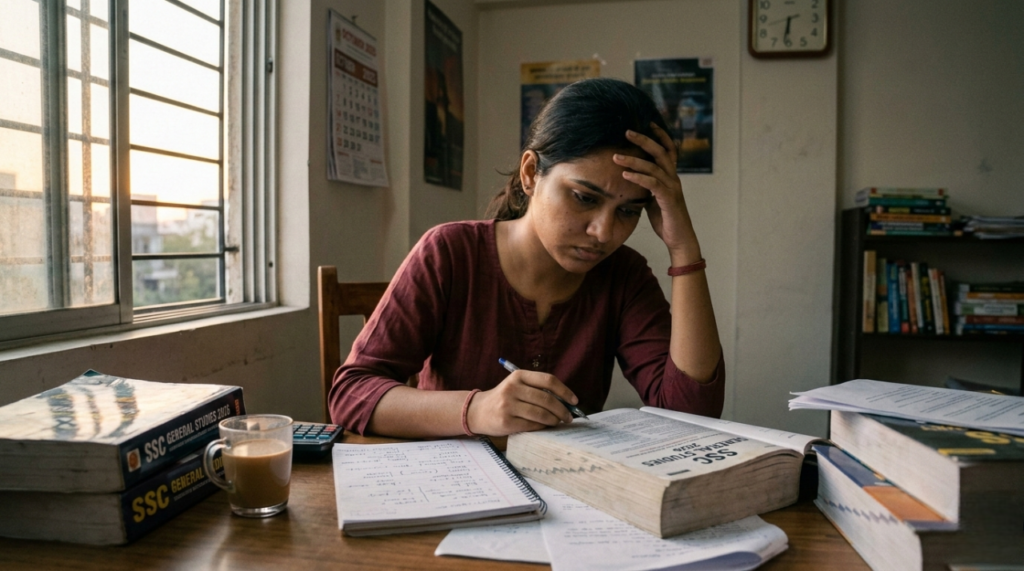
Now this is the section most of you have been waiting for! Good preparation is what separates an SSC topper from an average aspirant. Here are some practical and proven SSC preparation tips 2026 that actually work.
1. Understand the Exam Pattern First
Before you even open a book, understand the exam pattern thoroughly. Know which subjects carry more weight and plan accordingly. For SSC CGL, Quant and English are high-scoring areas. For MTS, Reasoning and Basic Maths are key.
2. Get the Right Study Material
Don’t waste time buying ten different books. For each subject, stick to one standard reference book and supplement it with online resources and previous year papers.
- Maths: Rakesh Yadav or R.S. Aggarwal
- English: Neetu Singh or Plinth to Paramount
- Reasoning: Kiran’s SSC Reasoning or M.K. Pandey
- GK/GS: Lucent’s GK + Monthly Current Affairs magazines
3. Practice Previous Year Papers – A Lot!
This is non-negotiable. Solving at least 10–15 years of previous year papers will give you a clear idea of the question pattern, difficulty level, and most repeated topics. Many questions in SSC exams are directly repeated or slightly modified from previous years.
4. Take Mock Tests Regularly
Online mock tests are your best friend for SSC preparation. They help you improve your speed and accuracy, manage time under pressure, and identify your weak areas. Take at least one full mock test per week and analyse your performance.
5. Build a Strong Current Affairs Habit
For the GK section, current affairs from the last 6–8 months before the exam are crucial. Read a daily newspaper (The Hindu or Hindustan Times), follow a monthly current affairs magazine, and watch short YouTube summaries.
6. Focus on Weak Areas, But Don’t Ignore Strengths
Many students make the mistake of only studying their weak subjects and neglecting the ones they are good at. Balance is key. Allocate more time to weak areas but keep revising your strong subjects regularly.
7. Create a Realistic Timetable
Make a daily study schedule that is challenging but achievable. A 6–8 hour study day is realistic for most aspirants. Include short breaks every 90 minutes and keep Sundays for revision or mock tests.
8. Revise, Revise, Revise
Revision is the backbone of SSC preparation. No matter how much you study, if you do not revise, you will forget. Make short notes of formulas, important dates, and vocabulary words and revise them daily.
Why SSC Exam 2026 is a Game-Changer for Your Career
The question everyone asks is: Is it actually worth the grind in 2026? If you’re looking for a career that lets you sleep peacefully at night, the answer is a big yes. Here is the reality of what life looks like once you cross that finish line:
Why SSC is Still the “Dream” for 2026
1. The “Bulletproof” Career (Stability)
In a world of “recessions” and “layoffs,” a central government job is as secure as it gets. You aren’t just getting a job; you’re getting a lifetime partnership with the government. Unless you do something truly wild, you have a guaranteed paycheck and a clear path until retirement.
2. Money in the Bank (The Paycheck)
The 7th Pay Commission ensures you’re paid well from Day 1. By 2026, with Dearness Allowance (DA) expected to be around 50–58%, your starting “in-hand” salary is looking very healthy:
- Top CGL Posts (Level 7/8): You could be taking home anywhere from ₹75,000 to ₹95,000+ per month in cities like Delhi or Mumbai.
- Entry Level (Level 4): Even at the starting levels, you’re looking at ₹40,000 to ₹50,000, plus perks like house rent and travel allowances.
3. You Get Your Life Back (Work-Life Balance)
While your friends in the private sector might be answering “urgent” emails at 10 PM on a Saturday, most SSC roles are strictly 9-to-5.
- Weekends Off: Most central ministries follow a 5-day week.
- Holidays: You get every gazetted holiday, plus a generous bucket of casual and earned leaves.
4. Moving Up the Ladder (Growth)
You don’t have to “job hop” to get a raise. Between 3% annual increments and twice-a-year DA hikes, your salary grows even if you stay in the same spot. If you’re ambitious, clearing departmental exams can fast-track your promotions by years.
5. The “Izzat” Factor (Social Status)
Let’s be honest—in India, telling your relatives you’re an “Income Tax Inspector” or an “ASO in the External Affairs Ministry” hits differently. It’s instant respect for you and immense pride for your family.
Conclusion
SSC Exam 2026 isn’t just a test—it’s one of the best shots you’ll ever have at building a rock-solid, meaningful career in the central government. Whether you’re locked in on CGL, CHSL, or MTS, the secret to winning isn’t just about how much you study, but how early you start and how consistently you show up.
Treat this guide as your roadmap. Bookmark ssc.gov.in right now so you’re always the first to know, get a real study plan on your wall, and whatever you do, don’t miss those notification dates. The climb is going to be steep and there will be days where it feels like a lot, but trust the process—the view from the top is worth every single hour of hard work.
You’ve got the grit, you’ve got the goal, now go get it. Best of luck for SSC 2026—you’ve got this!
Frequently Asked Questions (FAQ)
Q1. When will the SSC CGL 2026 notification be released?
Based on previous years’ trends, the SSC CGL 2026 notification is expected to be released between April and May 2026. The official SSC Annual Calendar will confirm the exact dates. Keep checking ssc.gov.in regularly.
Q2. Can I apply for multiple SSC exams in 2026?
Yes! If you meet the eligibility criteria for multiple SSC exams, you can apply for all of them. Many aspirants apply for both SSC CGL and SSC CHSL at the same time to maximize their chances.
Q3. What is the SSC eligibility criteria 2026 for SSC CGL?
For SSC CGL 2026, you need a bachelor’s degree in any discipline from a recognized university. The age limit for most posts is 18–32 years for general category candidates, with relaxation for reserved categories.
Q4. Is there negative marking in SSC exams 2026?
Yes. In most SSC exams, including CGL and CHSL Tier 1, there is a negative marking of 0.50 marks (half mark) for each wrong answer. SSC MTS Paper 1 does not have negative marking. Attempt questions you are reasonably confident about.
Q5. What is the application fee for SSC exams 2026?
The standard application fee for SSC exams is Rs. 100 for General/OBC male candidates. SC, ST, female candidates, and Ex-servicemen are generally exempt from paying the fee. Fees can be paid online through various payment modes.
Q6. How many months of preparation is needed for SSC CGL 2026?
If you are starting fresh, a preparation window of 6 to 12 months with consistent 6–8 hours of daily study is generally recommended for SSC CGL. If you are a regular aspirant who has already covered the basics, 3–4 months of intensive revision and mock tests should be sufficient.
Why Trust This Guide?
This guide wasn’t just thrown together; it was crafted by SSC experts and educators who live and breathe recruitment trends. We’ve double-checked everything against the SSC Annual Calendar 2026-27, historical data, and official government updates.
We take your trust seriously and stick to strict accuracy guidelines—that means no “clickbait” and no guessing. Every date and detail here is researched to be as precise as possible. That said, the SSC can sometimes shift things around, so we always recommend making ssc.gov.in your home base for the final word before you hit that “Apply” button.