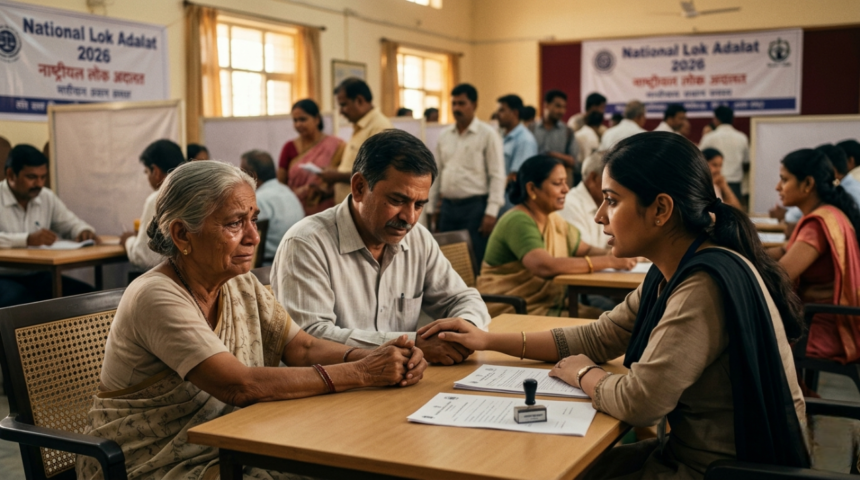
If you have a pending court case, a traffic challan, or a bank loan dispute, the National Lok Adalat 2026 could be your best chance to settle it quickly, peacefully, and without spending a lot of money.
- Latest News About Lok Adalat 2026
- What is Lok Adalat?
- Legal Basis: The Legal Services Authorities Act 1987
- National Lok Adalat 2026 Schedule
- Types of Cases Settled in Lok Adalat
- Benefits of Lok Adalat
- How to Participate in Lok Adalat
- Lok Adalat vs Regular Court: A Quick Comparison
- Conclusion
- Frequently Asked Questions (FAQ)
- Why Trust This Article
Every year, the National Legal Services Authority (NALSA) organizes Lok Adalats across India to help ordinary people resolve their legal disputes without the long delays of regular courts. In 2026, these Lok Adalats are again bringing hope to crores of citizens.
This article covers the latest news, schedule, types of cases, and how you can participate in National Lok Adalat 2026 in simple, easy language.
Latest News About Lok Adalat 2026
NALSA has officially rolled out its 2026 National Lok Adalat schedule, marking a busy year for judicial settlements across every Indian state and union territory. The first major session wrapped up this March, drawing an incredible crowd and clearing a massive backlog. Millions of cases, ranging from early-stage disputes to long-standing court battles, were resolved in a single day, offering a huge relief to the overstretched legal system.
This particular March event stood out because it prioritized the headaches that bother regular people most. Instead of complex corporate litigation, the focus stayed on settling motor accident claims, unpaid electricity bills, and the endless pile of pending traffic challans. By targeting these everyday grievances, the authorities managed to provide immediate closure to families who might have otherwise spent years navigating standard courtroom bureaucracy.
To make this happen, State Legal Services Authorities worked hand-in-hand with district courts and high courts to keep things moving. The process was straightforward: citizens just had to apply early and show up, either on their own or with legal counsel. The atmosphere was geared toward compromise rather than conflict, which is exactly why it was so effective.
While the March session is over, the year is far from finished. NALSA will be announcing more dates for the coming months soon. If you have a lingering legal issue, you should keep a close eye on the official NALSA portal or your local state authority website for the next opportunity to settle your case.

What is Lok Adalat?
Translating to “People’s Court,” the National Lok Adalat 2026 functions as a unique forum offering an alternative route to settle disputes outside the grueling traditional court system. Essentially, the National Lok Adalat 2026 provides a platform where opposing parties sit together to reach a mutual agreement guided by judicial officers. In the National Lok Adalat 2026, there is no winner or loser; instead, both sides find a solution that works for everyone involved.
The core philosophy of the National Lok Adalat 2026 is rooted in India’s ancient tradition of community dialogue and consensus. By participating in the National Lok Adalat 2026, citizens help reduce the massive burden on formal courts while finding a much faster path to justice. These sessions during the National Lok Adalat 2026 are far more than informal meetings; they carry full legal weight. Any settlement reached during the National Lok Adalat 2026 is treated exactly like a civil court decree.
One of the most defining features of the National Lok Adalat 2026 is that its decisions are final and cannot be challenged in any other court. This finality makes the National Lok Adalat 2026 one of the most powerful, cost-effective, and people-friendly legal tools available in India today. Whether it is a pending case or a pre-litigation matter, the National Lok Adalat 2026 ensures that justice is accessible, immediate, and binding for every citizen who chooses to participate in this nationwide effort.
Legal Basis: The Legal Services Authorities Act 1987
Operating under the Legal Services Authorities Act 1987, the National Lok Adalat 2026 is backed by a powerful law designed to bring free legal help to those who need it most. This legislation paved the way for the National Legal Services Authority (NALSA) to guide the National Lok Adalat 2026, while state and district branches ensure the National Lok Adalat 2026 reaches every corner of the country.
The Act gives the National Lok Adalat 2026 the same authority as a civil court, making every settlement reached during the National Lok Adalat 2026 final and binding. One of the best parts about the National Lok Adalat 2026 is the financial relief it offers; there are no court fees for filing a case. If your matter is already in court and you settle it through the National Lok Adalat 2026, you actually get your original court fee refunded.
This unique legal setup makes the National Lok Adalat 2026 an incredibly affordable way for regular people to find justice. By participating in the National Lok Adalat 2026, you aren’t just saving time; you are using a system designed to be both accessible and financially smart.
National Lok Adalat 2026 Schedule
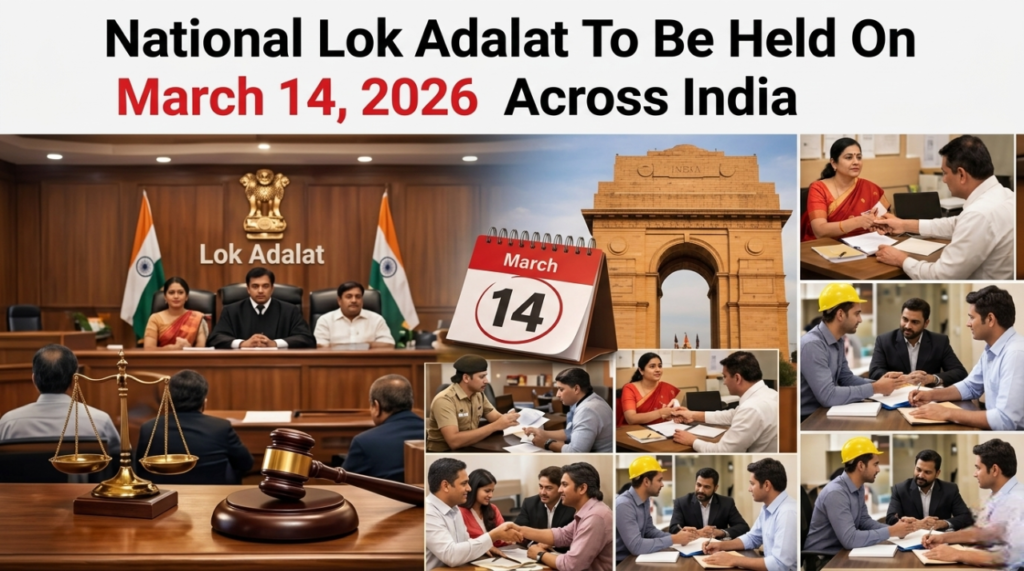
NALSA has laid out a clear roadmap for the National Lok Adalat 2026, with sessions happening simultaneously at every level, from the Supreme Court down to local Taluka Courts. For the National Lok Adalat 2026, the official calendar typically features four major nationwide events. The first big date for the National Lok Adalat 2026 is actually set for March 14, 2026, across most states, though Delhi has moved its session to March 22, 2026.
According to the confirmed schedule, the National Lok Adalat 2026 will return on May 9, September 12, and December 12. These dates for the National Lok Adalat 2026 are picked to give people regular opportunities throughout the year to settle their headaches. Beyond these massive events, you will also see State and District versions of the National Lok Adalat 2026 happening even more frequently to keep the momentum going.
If you want to be part of the National Lok Adalat 2026, it is a good idea to check in with your local District Legal Services Authority. They can give you the exact timing and registration steps for the National Lok Adalat 2026 in your specific town. Participating in the National Lok Adalat 2026 is the fastest way to turn a long-standing legal battle into a closed chapter.
Types of Cases Settled in Lok Adalat
One of the best things about Lok Adalat is that it handles a wide range of cases. Whether you have a personal dispute, a traffic fine, or a bank loan issue, there is a good chance it can be settled through Lok Adalat.
Motor Accident Compensation Cases
These are among the most common cases settled in Lok Adalat. If someone has been injured in a road accident and is waiting for compensation from an insurance company, Lok Adalat can help reach a quick and fair settlement. Insurance companies are often willing to settle these cases in Lok Adalat because it saves them time and legal costs as well.
Traffic Challan Settlement
Lok Adalat traffic challan settlement is one of the most popular reasons why people attend these events. If you have unpaid traffic challans or pending traffic violation fines, you can get them settled at a Lok Adalat, often at a reduced amount.
Many state traffic police departments coordinate with Lok Adalats to offer citizens a chance to clear their dues without paying the full fine or facing further legal action. This has resulted in the settlement of lakhs of traffic challans during each National Lok Adalat event.
Bank and Financial Institution Cases
If you have a dispute with a bank over a loan, credit card due, or recovery notice, Lok Adalat can help you reach a settlement. Banks often agree to waive off a portion of the interest or penalty in exchange for a one-time settlement. This is beneficial for both the borrower and the bank.
Electricity and Utility Bill Disputes
Cases involving unpaid electricity bills or disputes with electricity boards are regularly taken up in Lok Adalat. Consumers can negotiate a settlement and clear their dues without facing disconnection orders or legal proceedings.
Matrimonial Cases
Lok Adalat handles matrimonial disputes such as divorce by mutual consent, maintenance issues, and related family matters. However, it does not handle cases involving contested divorce or non-compoundable matrimonial offences.
Labour and Employment Disputes
Cases related to wages, gratuity, and employment disputes between workers and employers can also be settled through Lok Adalat. This is especially helpful for daily wage workers and employees of small businesses who cannot afford lengthy legal battles.
Cheque Bounce Cases
Cases filed under Section 138 of the Negotiable Instruments Act for cheque dishonour are frequently taken up in Lok Adalat. Both parties can reach a settlement and avoid the prolonged legal process.
Municipal and Local Body Disputes
Disputes involving property tax, water charges, and other civic issues with local bodies and municipal corporations can also be addressed in Lok Adalat.
Land and Property Disputes (compoundable cases only)
Certain civil disputes related to property and land that are compoundable in nature can be presented before Lok Adalat for settlement.
It is important to note that Lok Adalat does not handle cases involving non-compoundable offences such as murder, rape, or serious criminal offences. Only disputes that are civil in nature or compoundable criminal offences are eligible.
Benefits of Lok Adalat
There are many reasons why people choose the National Lok Adalat 2026 over traditional court proceedings. Let’s look at the main benefits in a simple and clear way.
No Court Fee One of the biggest perks of the National Lok Adalat 2026 is that you don’t have to pay any court fees. This is a massive relief for anyone worried about high legal costs. If your case was already in a regular court, the fee you previously paid is actually refunded once you settle during the National Lok Adalat 2026.
Fast Dispute Resolution Standard cases can drag on for decades, but the National Lok Adalat 2026 resolves matters in a single day. This saves years of waiting and removes the mental stress that usually comes with legal battles.
The Decision is Final Any agreement reached during the National Lok Adalat 2026 has the same legal weight as a court order. It is final and cannot be appealed, giving both sides total peace of mind.
Simple Rules The National Lok Adalat 2026 follows a flexible process without complicated formalities. You can speak freely, and mediators help everyone find a common ground.
Privacy and Relationships Proceedings during the National Lok Adalat 2026 are confidential, which is great for sensitive family issues. Because the National Lok Adalat 2026 focuses on mutual agreement rather than a “winner takes all” verdict, it helps keep relationships intact. Plus, if you can’t afford a lawyer, the National Lok Adalat 2026 framework provides free legal aid to ensure everyone has a fair shot at justice.
How to Participate in Lok Adalat
Participating in a Lok Adalat is not complicated. Here is a simple step-by-step guide to help you understand the process.
Step 1: Check Eligibility
First, find out if your case or dispute is eligible for Lok Adalat. Generally, any compoundable dispute, pre-litigation matter, or pending civil case can be brought to Lok Adalat. Contact your nearest District Legal Services Authority for guidance.
Step 2: Submit an Application
You can apply to participate in Lok Adalat by submitting an application to the District Legal Services Authority (DLSA) or the Taluk Legal Services Committee in your area. Forms are available at the DLSA office or on the official NALSA website.
Step 3: Get a Notice Date
After your application is reviewed and accepted, both parties will be sent a notice with the date, time, and venue of the Lok Adalat. Make sure to attend on the scheduled date.
Step 4: Attend the Lok Adalat
On the day of the Lok Adalat, both parties appear before the bench, which usually consists of a sitting or retired judicial officer and other members. They listen to both sides and help them arrive at a mutual agreement.
Step 5: Accept the Settlement
If both parties agree on a settlement, the Lok Adalat passes an award. This award is signed by both parties and the bench members. It becomes legally binding immediately.
Step 6: Receive Refund of Court Fee (if applicable)
If your case was already filed in a regular court, you will receive a refund of the court fee paid earlier once the Lok Adalat settlement is recorded.
For pre-litigation cases (disputes not yet filed in court), you can approach the DLSA directly before filing a case in court. This is even faster and more cost-effective.
Lok Adalat vs Regular Court: A Quick Comparison
| Feature | Lok Adalat | Regular Court |
|---|---|---|
| Time taken | One day or few sessions | Months to years |
| Court fee | Not required | Required |
| Fee refund | Yes, if case was filed | No refund |
| Appeal allowed | No, award is final | Yes, can be appealed |
| Process | Simple and flexible | Formal and procedural |
| Confidentiality | Yes | No (open hearings) |
| Legal aid | Available free | Lawyer needed (cost) |
| Relationship preservation | Yes | Often adversarial |
Conclusion
The justice system in India offers a powerful and friendly way for regular people to settle their legal troubles. Whether you are a farmer, a student, or own a small shop, this initiative gives you a real shot at fairness without wasting years in court or spending a fortune on lawyers.
Think about the relief of clearing a two-year-old traffic ticket, a stressful bank loan dispute, or an accident claim that has been stuck for months. All of these can be settled in a single day. There are no long hearings, no confusing paperwork, and no heavy costs. The system works because it is built on mutual agreement. When both sides sit down and find a solution they both like, the result is always better than a judge forcing a decision.
Since the 1987 law gave this system its foundation, authorities have worked hard to make it easier to use. The numbers are huge—millions of cases are closed during these events, meaning millions of families finally get to move on with their lives.
If you have a legal problem, don’t ignore this opportunity. Visit your local district legal office, ask about the upcoming dates, and submit your application. Justice does not have to be slow, expensive, or stressful. Stay informed and help others by sharing this, because the right information can truly change someone’s life.
Frequently Asked Questions (FAQ)
Q1. What is the date of National Lok Adalat 2026?
The first National Lok Adalat of 2026 was held on 8 March 2026. Further Lok Adalats are expected in May, July, September, and November 2026. Check the official NALSA website or your state legal services authority for confirmed dates.
Q2. Can I settle a traffic challan in Lok Adalat?
Yes. Lok Adalat traffic challan settlement is one of the most common services offered during National Lok Adalat events. You can clear pending traffic fines, often at a reduced amount, by attending the nearest Lok Adalat.
Q3. Is the Lok Adalat award final?
Yes. Under the Legal Services Authorities Act 1987, the award passed by a Lok Adalat is treated as a decree of a civil court. It is final and binding on both parties and cannot be challenged in any court.
Q4. Do I need to pay any fee for Lok Adalat?
No. There is no court fee for participating in Lok Adalat. If your case was already filed in a regular court, the original court fee paid by you will be refunded after settlement.
Q5. What types of cases cannot be settled in Lok Adalat?
Cases involving non-compoundable criminal offences such as murder, rape, dacoity, and other serious crimes cannot be taken up in Lok Adalat. Only civil disputes and compoundable offences are eligible.
Q6. How do I apply for Lok Adalat in my district?
You can contact your nearest District Legal Services Authority (DLSA) office or visit the official NALSA website to submit an application. You can also seek help from a lawyer or legal aid clinic in your area.
Why Trust This Article
This summary is based on official records from the Ministry of Law and Justice and the Legal Services Authorities Act 1987.
- Verified Basis: All facts align with established legal provisions and NALSA’s official guidelines.
- Public Purpose: This content simplifies legal rights for ordinary citizens to improve awareness.
- Non-Legal Advice: These details are for informational use and do not replace professional legal counsel.
- Action Step: For specific disputes, consult a qualified lawyer or your local District Legal Services Authority.