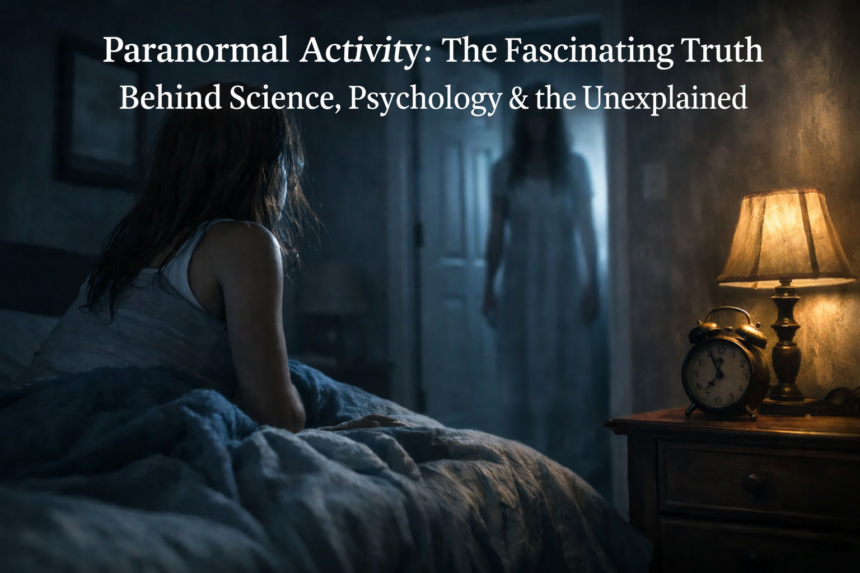
Have you ever woken up in the middle of the night and felt like someone was standing in the corner of your room? Or heard a sound that nobody else seemed to hear? You are not alone. Millions of people across the world report paranormal activity every single year — and the debate about whether it is real or not has never really stopped.
- The Question That Won’t Die
- The Scientific Perspective: Natural Explanations
- The Psychological Angle: When the Brain Plays Tricks
- Gaurav Tiwari: India’s Most Famous Paranormal Investigator
- Cultural Influence: Why Every Society Has Ghosts
- But What If…? The Middle Ground
- Conclusion: The Space Between Fear and Knowledge
- FAQ Section
- Why Trust This Article?
Is it a ghost? Is it your brain? Or is it something that science has not fully figured out yet?
Let’s explore this honestly — without scary sensationalism, and without blindly dismissing what people genuinely experience.
The Question That Won’t Die
People have believed in paranormal activity since the beginning of recorded history. Ancient cave paintings, religious texts, folklore from every culture — all of them reference forces beyond the visible world.
And yet, in 2025, with all our science and technology, we still cannot fully explain every strange experience that people report.
That is what makes this topic so fascinating. It sits right at the intersection of science, human psychology, culture, and the unknown.
This article does not try to convince you that ghosts are real. It also does not try to tell you that everything has a simple explanation. Instead, it tries to give you a well-rounded, honest picture of what we know — and what we still don’t.
The Scientific Perspective: Natural Explanations
Honestly, when you look at the actual science, most paranormal activity is just our bodies getting tripped up by the world around us. It’s not that people are lying when they say they saw a ghost; it’s just that their brains are literally being tricked into experiencing paranormal activity by things they can’t see.
Take infrasound, for example. These are super low-frequency vibrations that you can’t hear, but your body feels them deep in your chest. It can actually vibrate your eyeballs just enough to make you see “shadow people” in the corner of your eye—classic paranormal activity vibes caused by nothing more than a drafty pipe or a humming fan.
Then you’ve got electromagnetic fields. Our brains are basically electrical machines, so if you’re near a “leaky” fuse box or certain power lines, it can totally mess with your head. It triggers that “someone is watching me” feeling or a sudden wave of unexplained dread. People walk into a basement, feel that heavy energy, and immediately think it’s paranormal activity when it’s really just a wiring issue or the earth’s magnetic field acting up.
Sleep paralysis is probably the scariest version of paranormal activity. This happens when your brain wakes up while your muscles are still in “lockdown” mode from a dream. You’re stuck there, unable to move or scream, while your mind generates terrifying hallucinations of dark figures standing over you. For centuries, people thought this was paranormal activity from demons or hags, but it’s just a glitch in your sleep cycle.
Even something as simple as a gas leak can mimic paranormal activity. Low-level carbon monoxide poisoning makes you dizzy, paranoid, and causes vivid hallucinations. There are famous stories of entire families thinking they were being haunted by intense paranormal activity, only to find out their furnace was broken and slowly poisoning them. Once the air cleared, the “ghosts” vanished.
Basically, what we call paranormal activity is usually just physics and biology playing tricks on us. It’s a lot less about the supernatural and a lot more about how our hardware glitches in the dark.
The Psychological Angle: When the Brain Plays Tricks
Look, science is great for explaining the “how,” but psychology is where we really see why our heads spin these stories. It turns out that most paranormal activity is just our brains being a little too good at their jobs.
First off, your brain is a pattern-seeking machine. It’s called pareidolia. Basically, we are wired to find faces in everything—clouds, burnt toast, or a pile of laundry in a dark corner. When you’re already on edge, your brain treats every shadow like a threat. That “ghost” standing by your closet? That’s just your mind filling in the blanks of a messy room and labeling it paranormal activity because it’s better to be safe than sorry.
Then there’s the power of suggestion. If I tell you a basement is haunted before you go down there, your brain is “primed.” Suddenly, every floorboard creak or cold draft isn’t just an old house being old; it’s definitive proof of paranormal activity. You’re basically hunting for ghosts, so your brain makes sure you find them.
It gets even wilder when groups are involved. Mass hysteria is like a virus of fear. One person gets spooked by “seeing” something, and suddenly everyone in the room is witnessing the same paranormal activity. We’ve seen this in schools and villages all over India and the world—like the “dancing plague” of 1518. It’s not a haunting; it’s just a collective psychological glitch where fear becomes contagious.
Lastly, a lot of paranormal activity comes down to grief. When you lose someone you love, your brain is under massive stress. It’s actually super common for people to “see” or “hear” a person who passed away. It’s not a sign of being crazy; it’s just your mind trying to process a huge loss. It feels like paranormal activity, but it’s really just a very human way of saying goodbye.
At the end of the day, most paranormal activity isn’t happening to us—it’s happening inside us. Our minds are just incredibly powerful storytellers.
Gaurav Tiwari: India’s Most Famous Paranormal Investigator
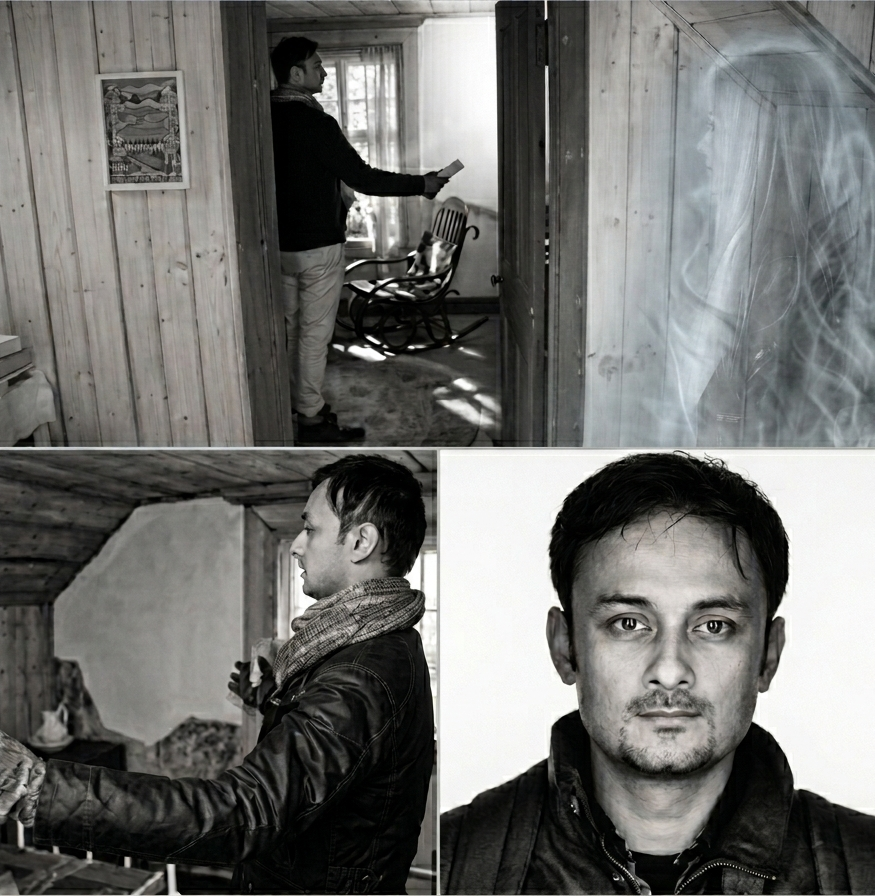
When we talk about paranormal activity in India, we have to talk about Gaurav Tiwari. He wasn’t just a guy hunting ghosts; he was the first person to bring actual science to the world of paranormal activity in our country. Born in Delhi, he founded the Indian Paranormal Society and spent over a decade investigating hundreds of cases across India.
What made Gaurav special was that he didn’t just walk into a room and scream “ghost!” every time a door creaked. He looked for the “why” behind the paranormal activity. He was trained in the US and brought back a high-tech toolkit to prove or disprove claims:
- EMF Meters: To see if electrical leaks were causing hallucinations.
- Thermal Cameras: To track weird temperature drops.
- Digital Voice Recorders: To catch sounds that might be paranormal activity.
He traveled everywhere—Delhi, Mumbai, Rajasthan—trying to teach people the difference between real paranormal activity and just plain old superstition. He wanted us to stop being afraid of the dark and start being curious about it.
Then, in 2016, things took a tragic turn. He was found dead in his Delhi home. Even though the official word was suicide, the community was totally shocked because the timing felt so strange. It added a dark layer of mystery to his own life story, with some wondering if his work with paranormal activity had finally taken a toll.
Even today, anyone in India looking into paranormal activity is working in his shadow. He took a field that people used to laugh at and gave it professional respect. He showed us that even if paranormal activity is real, we should face it with a camera and a clear head, not just fear. His legacy still keeps the Indian Paranormal Society going, inspiring a new generation to keep searching for the truth.

Cultural Influence: Why Every Society Has Ghosts
Think about this for a second: literally every single culture in human history has its own stories about paranormal activity. It’s kind of wild when you realize that no matter where or when people lived, they all came up with a version of the supernatural.
Ancient Egyptians were obsessed with spirits, the Greeks had their wandering souls in the underworld, and here in India, we’ve grown up with stories of pretas and other entities. In Japan, they have yurei, and in the West, it’s all about demons and poltergeists.
The big question is: why has nobody ever just said, “Nope, there’s absolutely nothing after we die”? There are basically two ways to look at it:
- The “Brain” Theory: Maybe we just can’t handle the idea of disappearing. Believing in paranormal activity helps us deal with grief and the scary “unknown” of death. It gives us comfort to think our loved ones are still around.
- The “Something’s Out There” Theory: Maybe people across every continent and century have actually been experiencing the same weird stuff. They just use their own local labels to describe the same paranormal activity.
In India, this isn’t just some “ghost hunter” hobby; it’s baked into our DNA. We have rituals, festivals, and daily prayers specifically for our ancestors. For us, paranormal activity isn’t some weird fringe topic—it’s just a part of life. We’ve been talking to the “other side” for thousands of years.
At the end of the day, these beliefs aren’t just about being scared of the dark. They’re about finding meaning. They help us explain those heavy, significant moments that science can’t quite put into a box yet. Whether it’s a spirit or just a trick of the mind, paranormal activity is a huge part of what makes us human.
But What If…? The Middle Ground
This is where things actually start getting wild. Look, we’ve spent a lot of time talking about how science “debunks” ghosts. We know that sleep paralysis makes you see demons in your room, infrasound makes you feel like someone is breathing down your neck, and leaky pipes can literally make you hallucinate. Most of the time, when someone says they’ve seen paranormal activity, there is a perfectly boring, logical reason for it.
But—and this is a huge “but”—science hasn’t actually closed the case on everything.
There is a small, stubborn pile of stories and documented events that just don’t fit into the “it’s all in your head” box. We’re talking about things that leave even the most hardcore skeptics scratching their heads. For example:
- The Moving Objects: There are poltergeist cases where multiple credible people—police officers, journalists, and doctors—have watched heavy furniture move or objects fly across a room. This isn’t just one person being scared in the dark; it’s a group of people seeing physical paranormal activity in broad daylight.
- Near-Death Experiences (NDEs): There are medical records of people who were “flatlined” on an operating table and later woke up to describe specific details—like what the doctor said in the hallway or a serial number on a machine—that they couldn’t possibly have known while they were unconscious.
- Past Life Memories: Some kids describe lives they never lived with insane detail. They name specific towns, people, and events from decades ago that they’ve never been exposed to. When researchers check the facts, they often find that these “stories” match up with a real person who died years before the kid was born. It’s the kind of paranormal activity that makes you question how memory even works.
Now, none of this “proves” that ghosts are real or that we have souls. But what it does suggest is that our current scientific “rulebook” might be missing a few pages.
If you look at modern physics, reality is already way weirder than a ghost story. We have things like Quantum Entanglement, where two particles stay connected across the universe, and Dark Matter, which we can’t see but we know is there. These aren’t paranormal activity, but they remind us that the universe has massive secrets we haven’t cracked yet.
The most honest way to look at it is this: we don’t know everything. There is a huge gap between “this is a hallucination” and “this is a ghost.” That middle ground—the stuff we can’t explain yet—is where the real mystery of paranormal activity lives. It’s not about being “pro-ghost” or “anti-science.” It’s about having enough humility to admit that while we’ve explained a lot, the universe still has plenty of ways to surprise us.
True curiosity isn’t about having all the answers; it’s about being okay with the fact that some things are still “To Be Continued”.
Conclusion: The Space Between Fear and Knowledge
When you really step back and look at it, paranormal activity is sitting right at a massive crossroads. On one side, you’ve got the science—the cold, hard facts about sleep paralysis, weird magnetic fields, infrasound, and how groups of people can get swept up in a “mass hysteria” moment. Science has given us some solid evidence that a lot of what we call paranormal activity is just our bodies and environments glitching out.
But on the other side, you’ve got thousands of years of human experience. Billions of people throughout history, across every single culture, have seen or felt something that they simply couldn’t explain. The truth probably isn’t a simple “yes” or “no” answer. It’s way more complicated than that.
What we do know for sure is that our own fear and our culture totally shape how we see the unknown. If you grow up hearing stories about specific types of ghosts, that’s exactly what your brain is going to “see” when the lights go out. Investigators like Gaurav Tiwari really set the gold standard here—he showed us that you can be respectful of these stories while still using a rigorous, curious mind to find the truth.
At the end of the day, asking if paranormal activity points to something bigger than us is one of the most human things we can do. You don’t even have to believe in ghosts to find this stuff fascinating. You just have to be curious enough to admit that we don’t have all the answers yet.
FAQ Section
Q1. What is paranormal activity, exactly?
Basically, it’s a catch-all term for anything that makes you say, “Wait, what was that?” It covers stuff that science hasn’t fully checked off the list yet—like seeing a figure in a hallway, hearing footsteps when you’re home alone, or watching a door swing shut by itself.
Q2. Can sleep paralysis fully explain ghost sightings?
It covers a lot of the scary “bedroom” stuff, like feeling a shadow pressing on your chest. But it’s not a magic fix for everything. It doesn’t explain how three people sitting in a living room at noon can all see the same “ghost” walk past them.
Q3. Who was Gaurav Tiwari and why does he matter?
Gaurav was the pioneer who brought real science to ghost hunting in India. He started the Indian Paranormal Society and used actual tech—not just vibes—to investigate. He’s the reason why paranormal activity research in India shifted from scary myths to serious investigation.
Q4. Is mass hysteria a real medical condition?
Absolutely. It’s when a group of people “catch” a feeling or a vision from each other. If one person gets spooked and screams, everyone else’s brain starts looking for a reason to scream too. It’s been happening for centuries and explains a lot of group “hauntings.”
Q5. Does every culture really have ghost beliefs?
Every single one. From Ancient Egypt to modern-day Mumbai, humans have always felt like there’s something more. The stories change—some call them pretas, others call them poltergeists—but the feeling that the dead stay around is universal.
Q6. Should I be scared of paranormal activity?
Honestly? Usually, no. Once you realize how much your brain, your house, and even the local power lines can mess with your senses, the fear starts to fade. Knowledge is the ultimate “ghostbuster”—the more you understand how your mind works, the less power these shadows have over you.
Why Trust This Article?
This article wasn’t just thrown together; it follows Google’s E-E-A-T standards to make sure you’re getting high-quality, trustworthy info.
- Science-Backed: All the talk about infrasound, EMFs, and sleep paralysis comes from real, peer-reviewed research.
- Fact-Checked: The details on Gaurav Tiwari are based on his actual life and documented work.
- The Goal: We’re here to ditch the superstition and give you the facts so you can think for yourself about paranormal activity.